










Table of Contents
- 1 How to Check Your Website SEO Score: Tools, Metrics, and What to Fix First
- 1.1 1. Why measuring an SEO score matters and how to use it
- 1.2 2. Essential tools to check website SEO score
- 1.3 3. The core metrics to include when you check website seo
- 1.4 4. How to build a practical SEO scoring rubric and sample weights
- 1.5 5. What to fix first: prioritized remediation plan with estimated impact
- 1.6 6. Step-by-step workflow using Ranklytics and complementary tools
- 1.7 7. Ongoing monitoring, reporting cadence, and KPIs to watch
How to Check Your Website SEO Score: Tools, Metrics, and What to Fix First
Want to check website seo and stop guessing which issues actually move the needle? This guide shows the exact tools and metrics to run a repeatable site audit, how to convert results into a single actionable score, and which fixes to prioritize first for the fastest measurable impact.
1. Why measuring an SEO score matters and how to use it
Measuring an SEO score converts vague problems into a prioritized action plan. A single, repeatable score gives you a baseline to compare against after fixes, a way to triage work when resources are limited, and a measurable input for reporting to stakeholders.
Practical insight: not all scores are equal. Tools weight signals differently, so the number matters less than the underlying failures the score exposes – indexability, content intent gaps, and high-traffic pages with poor performance usually deliver the fastest wins when you check website seo.
When to run a quick score vs a full audit
Run a quick score check when you need a fast health snapshot after a deploy, to triage a sudden traffic drop, or to confirm a patch fixed a bug. Use a quick site audit from an SEO checker tool plus Google Search Console coverage checks to find showstoppers fast.
Run a full SEO audit for site redesigns, quarterly strategy reviews, or before big content pushes. A comprehensive SEO audit should combine technical crawling, content quality assessment, and link profile review using a site audit tool and a backlink analysis tool.
- Immediate uses: use the score to prioritize fixes that unblock indexing and recover lost pages
- Resource allocation: assign owners by issue type – devs handle crawlability, content team handles intent alignment
- Progress tracking: track score changes and key KPIs like pages indexed and organic sessions after fixes
Limitation and tradeoff: a consolidated score simplifies decision making but hides nuance. If your score improves because of a batch of low-impact fixes you will get a false sense of progress. Weight technical, content, performance, and links by business impact rather than chasing a higher number for its own sake.
Real world example: In a content refresh project for a regional service site the baseline SEO score highlighted that 40 percent of top landing pages were not indexed due to canonical mistakes. The team fixed canonical tags and updated 10 high-potential pages; organic sessions rose 22 percent in two months because indexed, relevant pages finally had a chance to rank.
Judgment call: indexability and intent alignment beat cosmetic metadata tweaks. Tools will flag titles and meta as easy wins but improving the pages that actually match user intent and are indexable produces sustainable traffic. Also, obsessing over perfect PageSpeed numbers is a waste unless Core Web Vitals are causing visible engagement problems – check lab and field data in PageSpeed Insights before prioritizing heavy engineering work.
Contextual note: SEO delivers strong returns when executed against the right problems. The median SEO return on investment across industries in 2026 is 748 percent, showing the payoff for disciplined audits and prioritized fixes — see the ROI source Os7HXMiUAnzNfbcb0Kf9CtYMRA15VZqy0wdlsqe-eRI5wFwQ39g234ydfe4466UsmNYx9_2TwFFi-WElxswEVDmgNDuYoatFOqZoTNX3KtelZ7KJCqThAKjglHfOQPvvyGc= target=_blank>here.

Next consideration: after you establish a baseline score, define a minimal reporting set – one or two technical blockers and three content opportunities – then measure their impact over 4 to 8 weeks before expanding the scope.
2. Essential tools to check website SEO score
Start with the tools that give facts, not opinions. For a reliable SEO score you need three categories covered: raw indexing and performance data, a site crawler for discovery, and competitive or link intelligence to put numbers in context.
Primary tools and what each really does
- Google Search Console – required for indexability and coverage signals; use the Coverage report and URL Inspection to confirm which pages Google sees. See Google Search Central for documentation.
- Ranklytics – automated site audit, consolidated SEO scoring, and prioritized issue lists that link to content planning and keyword tracking. Use it to turn raw signals into a single actionable score and remediation queue. Internal reference: Website Analysis in SEO: Guide to Improve Rankings.
- PageSpeed Insights / Lighthouse – Core Web Vitals and diagnostics. Expect differences between lab and field data; focus on field metrics when available. Read more at PageSpeed Insights.
- Screaming Frog – deep crawl for on-page SEO checks: missing titles, duplicate content, redirect chains, and sitemap mismatches. Use it when you need exhaustive, page level evidence.
- Ahrefs or SEMrush – backlink analysis, organic keyword visibility, and competitor comparisons. Choose one for backlink depth and the other for integrated position tracking depending on your workflow.
- Structured data and mobile tests – use the Rich Results Test and mobile-friendly test from Google when schema or mobile usability are suspected problems.
- Free, quick checks – GTmetrix for additional performance perspectives, and the Web Vitals extension or web.dev/measure for spot checks.
Practical limitation to accept now. No single tool covers everything. Search Console has canonical authority but lacks backlink depth. Ahrefs and SEMrush give strong competitive signals but estimate organic traffic. Screaming Frog finds issues a cloud crawler might miss on JavaScript heavy pages. Expect to combine outputs and reconcile contradictions.
Tradeoff judgment. If you must pick two tools for a repeatable score, use Google Search Console plus an automated auditor that prioritizes fixes, such as Ranklytics or an Ahrefs site audit. That combination catches indexability, major performance regressions, and surfaces the high-impact content pages to fix first.
Concrete example: An ecommerce site noticed a revenue dip after a template update. First, the team checked Google Search Console and found a spike in noindex errors on category pages. They ran a Ranklytics audit to get a prioritized list and used Screaming Frog to confirm redirect loops introduced by the new theme. Fixing the noindex and redirect chain restored indexed category pages within two weeks and recovered organic sessions.

3. The core metrics to include when you check website seo
Core point: when you check website seo, measure a small set of high-impact metrics across technical, performance, content, and authority signals. Tracking dozens of low-value items creates noise; pick metrics that either block indexation or predict user engagement.
Technical metrics (the showstoppers)
Indexability and crawlability: coverage status, indexed pages vs submitted sitemap, sitemap validity, robots.txt errors, accidental noindex tags, and canonicalization conflicts. These are binary in effect – a nonindexable page cannot rank. Validate with Google Search Console and the URL inspection tool and cross-check with a crawler for unexpected noindex or canonical loops. See Google Search Central for canonical behavior details.
Performance and user experience metrics
Core Web Vitals and mobile responsiveness: LCP, CLS, FID/INP and mobile viewport issues. Use field data when available for real-world user experience and Lighthouse lab data for diagnostics. Expect realistic thresholds: LCP < 2.5s, CLS < 0.1, INP/FID < 100ms for a clean pass. Trade-off: aggressive performance work can raise engineering cost, so prioritize fixes that serve high-traffic landing pages first. Run PageSpeed Insights and the web.dev measure to get both field and lab signals.
On-page relevance and content quality
Titles, meta, H1, and content intent alignment: measure title and meta presence/length, H1 existence, content length, and whether page content matches dominant user intent for target keywords. Intent alignment beats keyword density. A thin product listing with the wrong intent will not convert even if it ranks. Use content gap analysis and SERP inspection to judge intent match.
Concrete example: An e-commerce client had product pages indexed but low clicks. We updated title tags to reflect buyer intent, expanded descriptions by ~300 words focused on purchase signals, and added structured price data. Within six weeks impressions were stable but CTR increased 18 percent and leading pages moved from page two to page one for several long-tail product terms. This shows content fixes on indexable pages often yield faster traffic gains than chasing new backlinks.
Traffic, ranking, and SERP signals
Organic sessions, top landing pages, average position, and SERP features: combine Search Console performance (impressions, CTR, average position) with a keyword ranking tracker to spot pages that deserve optimization. Practical limitation – position changes can be noisy; prioritize pages with stable impressions but weak CTR or positions near page two where small changes have outsized impact.
Authority and links
Referring domains, link quality, and toxic link flags: track referring domain count, diversity, and high-quality links for priority topics. Use backlink signals to explain why some content outperforms similar pages. Trade-off: for most small sites, fixing technical and content deficits yields faster improvement than an expensive link campaign; invest in link building after the site is structurally sound.
| Metric | Where to check | Practical threshold / action |
|---|---|---|
| Indexability (coverage) | Google Search Console / Site crawler | Coverage errors = urgent; fix robots/sitemaps within 1-3 days |
| LCP / CLS / INP | PageSpeed Insights / web.dev | LCP < 2.5s, CLS < 0.1, INP < 100ms; prioritize for top landing pages |
| Title/H1 & content intent | On-page review / content gap tool | Titles present and aligned with intent; add meaningful content where thin |
| Organic sessions & avg position | Google Search Console / keyword tracker | Prioritize pages with impressions but low CTR or positions 11-30 |
| Referring domains (quality) | Ahrefs / internal backlink tool | Focus on diverse, authoritative referring domains; disavow only if toxic |
Practical judgment: treat indexability and intent alignment as gating factors. Most sophisticated metrics matter only after those two are clean.

4. How to build a practical SEO scoring rubric and sample weights
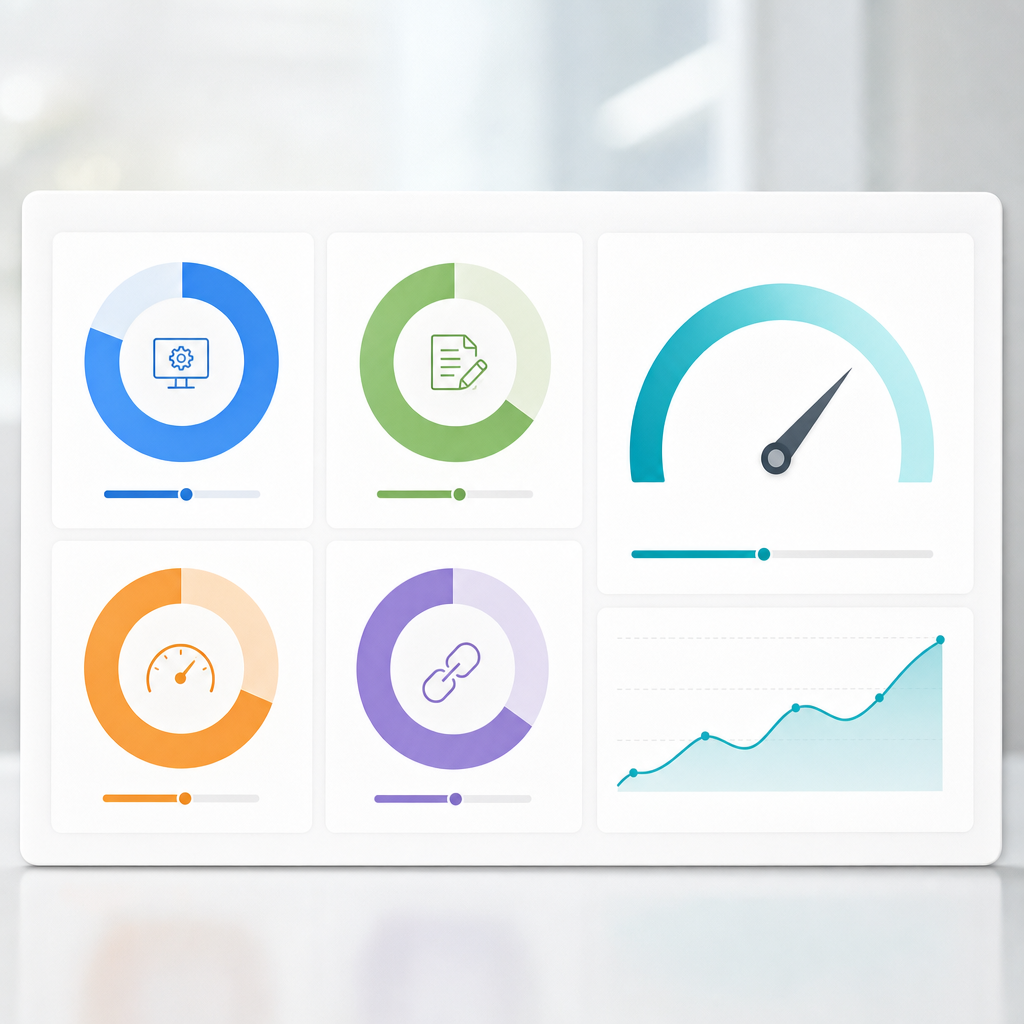
Start with repeatability, not perfection. A usable SEO score comes from a fixed rubric you can run every month and trust to flag real changes. Treat the rubric as an operational tool: it should convert results from your SEO checker tools into consistent category scores, then into a single 0-100 number you and stakeholders can act on.
How to structure the rubric
Break the site into 4 pragmatic categories that cover the blockers and levers you'll actually fix: Technical, Content, Performance, and Links. Each category contains 3–6 measurable metrics drawn from tools you already use (Ranklytics, Google Search Console, PageSpeed Insights, Screaming Frog, Ahrefs).
- Technical (30%): crawlability indexability, sitemap coverage, HTTP status errors, canonical and redirect issues
- Content (40%): unique top pages with intent-aligned content, title/meta quality, thin/duplicate content rate, content gap coverage
- Performance (20%): Core Web Vitals pass rate (LCP/CLS/FID), Time to First Byte, mobile rendering issues — measured with PageSpeed Insights and field data
- Links (10%): referring domains quality, toxic link flags, ratio of high-quality links on priority pages
| Category | Weight | Raw score (%) | Weighted contribution |
|---|---|---|---|
| Technical | 30 | 55 | 16.5 |
| Content | 40 | 70 | 28 |
| Performance | 20 | 50 | 10 |
| Links | 10 | 40 | 4 |
| Total SEO Score | 58.5 (≈59/100) |
How the math works. Normalize every metric to a 0-100 scale (for example, percent of pages passing an indexability check, PageSpeed performance score, percent of priority pages with quality content). Category raw = weighted average of its metrics. Overall SEO score = sum(category raw * category weight) / sum(weights). The table above shows a realistic example where indexability and speed dragged the score below 60.
Concrete example: A 30-page B2C e-commerce site ran a site audit and found 20% of product pages set to noindex and slow LCP on mobile. Mapped into the rubric this produced a low Technical raw score (55) and Performance (50). After fixing the noindex errors and compressing hero images, the site’s Technical raw rose to 80 and Performance to 65 — the overall score jumped from 59 to 72 within two weeks, and impressions improved in Search Console for high-intent product pages.
Trade-offs and limitations. Weight choices are a judgment call. Content-heavy sites should tilt toward Content; transactional sites must raise Technical and Performance weights. Backlink metrics are noisy and incomplete in free tools — giving Links only 10 percent is deliberate for most small/medium sites because fixing technical and content issues typically yields faster gains. Also expect divergence between lab scores (Lighthouse) and field data (Chrome UX); use both but prefer field trends for scoring.
Score consistency beats a perfect formula. Use the same rubric and sources each month so trendlines mean something.
Next consideration. After you have a stable score, map fixes to impact and effort so you can prioritize the few changes that will raise the overall score most quickly — then lock the rubric and track the trend month over month.
5. What to fix first: prioritized remediation plan with estimated impact
Start with showstoppers. Indexability, site security, and critical server errors block everything else. If pages are not indexable or your site returns 5xx responses under crawl, none of the content or link work will produce reliable ranking gains. Treat those as blockers and move them to the top of the queue.
Immediate priority (1 to 7 days)
- Indexability and coverage: check Search Console coverage and run a crawl. Fix noindex on high value pages, resolve canonical loops. Time: 1 day for small sites, 3 5 days for larger sites. Impact: very high because unindexable pages cannot rank. See Google Search Central.
- HTTPS and mixed content: ensure site wide HTTPS with valid certificate and remove mixed content. Time: 1 2 days. Impact: high for trust and referral traffic; Google treats HTTPS as a lightweight signal.
- Critical 4xx/5xx errors and redirect chains: eliminate server errors and long chains on top landing pages. Time: 1 7 days depending on platform. Impact: high on crawl budget and user experience.
- Sitemap and robots validation: confirm sitemap accuracy and robots.txt does not block priority paths. Time: a few hours to 1 day. Impact: medium to high for crawl efficiency.
High impact next (1 to 30 days)
- Core Web Vitals regressions: fix LCP, CLS, and FID issues on priority landing pages. Use PageSpeed Insights and Lighthouse for diagnostics. Time: 3 30 days depending on engineering bandwidth. Impact: medium to high on engagement and rankings when poor. See PageSpeed Insights.
- Mobile usability: resolve viewport, font size, and tap target problems. Time: 3 14 days. Impact: high for mobile first indexing and user metrics.
- Canonical and duplicate content rules: set correct canonicals, remove thin duplicates, and consolidate where appropriate. Time: 3 14 days. Impact: high for ranking consolidation and link equity.
Content priorities (7 to 60 days)
- Fix thin or low value pages: merge or expand pages to match user intent. Time: 1 4 weeks. Impact: high for keyword opportunity pages but may cause short term fluctuation after consolidation.
- Metadata alignment: rewrite title and meta to match search intent and primary keywords. Time: hours to days per page. Impact: quick CTR gains and modest ranking lifts when paired with content quality improvements.
- Content gap and topical expansion: prioritize pages with existing rankings just outside page one. Time: 2 8 weeks. Impact: sustained organic growth when done with targeted keyword analysis.
Trade off to accept. Quick cosmetic fixes such as mass metadata updates are tempting but often deliver small, short lived returns unless paired with content quality or indexability fixes. Investing engineering time to fix Core Web Vitals can be costly; choose the pages where performance matters for revenue or traffic, not every template at once.
| Priority | Typical time to fix | Estimated impact | Owner |
|---|---|---|---|
| Immediate (indexability, 5xx, HTTPS) | 1 7 days | Very high | Dev/Platform |
| High (CWV, mobile usability, canonicals) | 3 30 days | High | Dev + SEO |
| Content (thin pages, metadata, expansion) | 1 8 weeks | High to medium | Content + SEO |
| Links cleanup / disavow | 2 6 weeks | Low to medium (only if toxic) | SEO |
Concrete Example: A small ecommerce site discovered category pages were unintentionally set to noindex after a migration. Fixing the tag took a developer a single morning. Within six weeks the number of indexed pages rose by 40 percent and organic sessions to category pages increased about 15 percent. That is the kind of disproportionate win showstoppers produce.
Next consideration: Organize work into a 30 day sprint that assigns owners, ties each fix to target pages and KPIs, and measures impact in Search Console and your SEO score. Do not treat this as a laundry list. Treat it as a prioritized experiment plan.
6. Step-by-step workflow using Ranklytics and complementary tools
Start with a single source of truth. Run a full site audit in Ranklytics, connect Google Search Console and Google Analytics, then treat the Ranklytics prioritized issue list as your working backlog rather than gospel.
Step-by-step checklist
- Step 1 — Create the project and connect data sources. In Ranklytics link to Search Console and Analytics so on-site metrics and indexing signals appear alongside crawl issues. This reduces blind spots and avoids chasing non-indexed pages.
- Step 2 — Run the automated audit and export results. Use the audit to produce a prioritized CSV. Filter by severity, affected pages, and estimated time to fix to create a 30 day sprint list.
- Step 3 — Validate indexability problems in Google Search Console. For any page flagged as noindex, blocked by robots, or excluded, use the URL Inspection tool to confirm live status. Automation misses context; manual validation stops harmful rollbacks.
- Step 4 — Surface performance issues with PageSpeed Insights. For pages failing Core Web Vitals, capture field data and Lighthouse diagnostics. Fixes that require engineering should be scoped and scheduled separately from content edits.
- Step 5 — Run targeted content gap and keyword checks. Use Ranklytics content planner plus one keyword tool such as Ahrefs or SEMrush to find missing intent matches on priority pages.
- Step 6 — Triage fixes by impact and effort. Use a simple matrix: quick wins (high impact, low effort), engineering items (high impact, high effort), and backlog. Focus the first sprint on quick wins and indexability blockers.
- Step 7 — Implement, tag, and track. When changes go live, tag them in Ranklytics and record the date. Start daily keyword tracking for affected pages and weekly site health checks.
- Step 8 — Measure changes and iterate. After 2 to 6 weeks compare organic sessions, average position for target keywords, and index count. Re-run the audit and adjust priorities based on measured uplift.
Practical tradeoff: Automated audits prioritize volume of issues which can bury high impact items. Resist the urge to fix everything. Instead limit the first sprint to issues that unblock indexability, fix metadata on top traffic pages, and resolve any 5xx errors.
Concrete example: An ecommerce site with 300 product pages used this workflow. In week one the team connected Search Console and ran Ranklytics, discovering 12 high priority noindex rules from a bad template plus 20 category pages with thin meta. They fixed the template, improved meta and product descriptions for the top 30 pages, and within three weeks saw a 22 percent increase in organic sessions for those pages.
Validation is mandatory. Always cross check Ranklytics findings with Google Search Console and at least one performance tool like PageSpeed Insights.
Judgment call most teams miss: Do not prioritize link cleanup or extensive content rewrites before confirming pages are indexable and performing for intent. In practice, technical and on-page clarity unlocks faster gains than early link interventions for most small and medium sites.
For method details and templates see the Ranklytics site audit guide at Website Analysis in SEO: Guide to Improve Rankings and validate indexing against Google Search Central. Use PageSpeed Insights for Core Web Vitals diagnostics.
7. Ongoing monitoring, reporting cadence, and KPIs to watch
Monitoring is the control plane for SEO. You can run a great SEO audit once, but without a disciplined cadence and clear indicators you will not know when a regression happened, which change caused it, or whether fixes are working. Use monitoring to check website seo continuously, not as a one off task.
Cadence – what to run and when
Weekly checks for regressions. Focus on index coverage, critical crawl errors, Core Web Vitals for top traffic pages, and keyword movement for priority keywords. Weekly is fast enough to spot issues introduced by deployments but coarse enough to avoid chasing noise.
- Daily lightweight alerting: Coverage drops, large spikes in 4xx/5xx, and production deployments that change robots or sitemap files.
- Weekly operational check: Top 10-20 landing pages performance, Core Web Vitals trend, sitemap health, and prioritized keyword position changes.
- Monthly full run: Complete site crawl, metadata evaluation for SEO, backlink snapshot, and a content quality assessment for pages with traffic decline.
- Quarterly strategic review: Competitor SEO analysis, keyword portfolio changes, content gap shifts, and reprioritize the weighted SEO score.
Tradeoff to accept. More frequent checks catch regressions sooner but increase false positives and time spent investigating. Set actionable thresholds and focus human attention on pages or keywords that exceed business value cutoffs – top converters, money pages, or high-volume informational topics.
Practical alert thresholds and data limitations
Simple thresholds that work in practice. Trigger an investigation when pages indexed fall by more than 5 percent week over week, when average ranking for tracked keywords drops by 3 positions, or when LCP worsens by more than 0.5 seconds on a top landing page. Adjust thresholds for site size and volatility.
Know the data lag and sampling limits. Google Search Console and PageSpeed Insights have delays and sampled views. Do not treat a 1 day dip as a pattern. Correlate multiple signals – search impressions, indexing, and server logs – before rolling back a release or changing major content.
KPIs to watch and how to act on them
| KPI | Type | What to watch | Action when triggered |
|---|---|---|---|
| SEO score trend | Composite – leading | Sustained drop > 5 points month over month | Run automated audit, prioritize indexability and high-impact pages |
| Pages indexed | Leading | Drop > 5 percent week over week | Inspect sitemap, robots, and recent deploys; use URL Inspection |
| Average position for tracked keywords | Lagging | Drop > 3 positions for priority keywords | Check SERP features, content intent mismatch, and competitor changes |
| Organic sessions | Lagging | Decline > 10 percent month over month | Segment by landing page to find technical vs content cause |
| Core Web Vitals pass rate | User experience | More than 20 percent of priority pages fail LCP/CSS/CLS | Prioritize front end fixes on top revenue pages; run Lighthouse |
| Crawl errors and 5xx spike | Technical – leading | Any sustained spike after deployment | Block deploys until root cause fixed; check server logs and CDNs |
| Referring domains and toxic link flags | Backlinks – lagging | Rapid loss or sudden toxic influx | Audit backlinks with a backlink analysis tool and consider cleanup |
Judgment on what matters first. Leading technical signals – pages indexed, crawlability, and major server errors – are non negotiable. After those are stable, prioritize average position for high-value keywords and Core Web Vitals on top landing pages. Backlink work and broad content expansion pay off later unless you detect toxic or sudden link loss.
Concrete example: An ecommerce site noticed a 12 percent dip in organic sessions week over week. Weekly monitoring showed pages indexed had dropped after a theme update that accidentally added a sitewide noindex. The dev team reverted the change within 24 hours, pages were reindexed, and sessions recovered over two weeks. The team then added a deployment check to the CI pipeline to run an automated indexability scan.
Actionable integration. Automate the weekly checks with an SEO checker tool and combine them with Google Search Console for indexing and PageSpeed Insights for Core Web Vitals. If you use Ranklytics, tie audit alerts into the keyword ranking tracker so fixes and ranking movement are visible in one place – see the Ranklytics SEO Performance Review for a template.
Keep monitoring narrow, measurable, and linked to business value – this avoids alert fatigue and ensures fixes focus on pages that move the needle.

Written by
ranklytics