













Table of Contents
Emergency Locksmith Denver: Fast Response Options and How to Choose the Right Service
Locked out, broken key, or a late-night security worry — when minutes matter in Denver you need a locksmith who arrives fast and does the job without surprises. This guide breaks down the real fast-response options, what response times and credentials actually mean, and a short checklist for choosing the right service under stress. If you run a locksmith business or are vetting providers online, using seo content writing software can help you compare listings, verify reviews, and quickly assess ETA claims.
1. The four stage SEO content workflow and why each stage needs a different tool
Clear separation of work reduces friction. Planning, drafting, on-page optimization, and measurement each produce different outputs and signals — topic maps, briefs, optimized HTML and metadata, and time-series rank data. Trying to force one tool to do all of that well wastes budget and creates handoff gaps.
What each stage delivers and why a different tool matters
- Planning (topic selection and cluster mapping):
Topic clusters, prioritized keyword lists, and SERP intent breakdowns — tools: Ranklytics content planner for integrated planning,Semrush Topic Researchfor quick idea expansion,Ahrefs Content Explorerfor competitive discovery. - Drafting (briefs and first drafts): executable briefs and publishable first drafts — tools:
Ranklyticsfor brief generation,JasperorChatGPTfor accelerated drafting when paired with human editing, and Google Docs for collaborative passes. - On-page optimization (scoring and edits): header suggestions, NLP term recommendations, and live on-page scores — tools:
Surfer SEOfor TF-IDF based guidance,Clearscopefor relevance scoring,Frasefor brief-to-content alignment. - Measurement and rank tracking (validation and iteration): baseline ranking, lift by keyword, and pages needing refresh — tools:
RanklyticsorAhrefs Rank Trackerfor ongoing monitoring,Semrush Position Trackingfor competitor context and trend alerts.
Practical trade-off: Opting for a single all-in-one platform simplifies billing and reduces training, but specialist tools typically surface stronger, stage-specific signals — for example Surfer's page-level TF-IDF guidance will outperform a generalist at micro-optimization. Choose based on which stage is your current bottleneck: speed of output or depth of optimization.
Concrete example: A mid-market SaaS marketing team used Ranklytics to map a pillar page and select five long-tail targets, drafted initial content with ChatGPT plus an editor pass to fix hallucinations and E E A T gaps, then ran the pages through Surfer SEO to tighten headings and density. They published on a two-week cadence and used Ranklytics tracking to flag two underperforming pages for re-optimization after six weeks.
Limitation to plan for: Automation can make you faster but not better by itself. AI content writing software and seo writing tools produce drafts; they do not replace subject-matter review, reference checks, or a publisher who understands site architecture. Treat automated output as raw material, not a finished article.
Choose tools by the output they create: pick a planner for topic signals, a drafter for velocity, an optimizer for SERP-fit, and a tracker for measurable ROI.
content optimization software and separate tracking to avoid missed signals and false positives.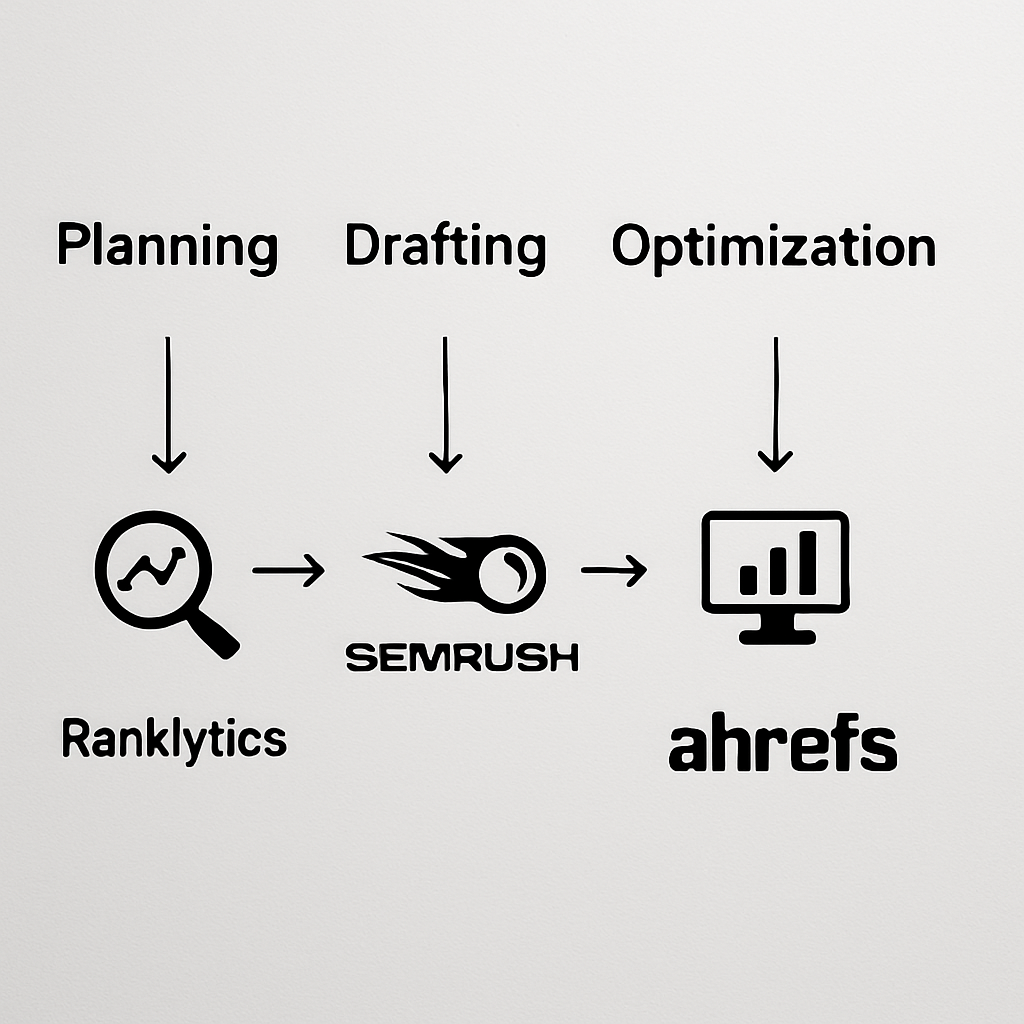
Next consideration: map your current bottleneck to a stage above and trial a specialist there for 30 days while keeping a single source of truth for briefs in Ranklytics.
Frequently Asked Questions
Direct answer first: pick tools by the job you need done, not by feature lists. Teams buy seo content writing software because they want predictable outputs: fewer drafts, faster publish, and measurable ranking moves. The procurement question is which stage each tool will own in your stack.
Short practical answers
- Can one platform truly replace specialist tools?: In practice, generalist platforms cover planning, drafting, and tracking well enough for small teams, but they rarely match specialist tools on stage-specific signals such as TF-IDF suggestions or deep topical authority modeling. Consider a hybrid: use an integrated planner like Ranklytics as the single source of truth and add a specialist optimizer when you need micro-level improvements.
- Is AI drafting safe to publish?: Use AI as a drafting accelerator only. Human review is mandatory to fix hallucinations, verify facts, and apply E E A T. Treat automated output as a time-saver, not a quality shortcut.
- Which metrics prove value?: Track ranking changes for target keywords, organic sessions to the pages you publish, and a conversion metric tied to the page (newsletter signups, demo requests). Tie those to time-to-publish so you can compare speed versus signal trade-offs from automation.
- How long before I see impact?: Expect meaningful movement in 4 to 12 weeks for mid-competition keywords. Faster changes happen for long-tail, low-competition queries; authority-limited sites will take the longer end of that window.
- Will multiple tools create redundant work?: They will if responsibilities are fuzzy. Define one tool as the canonical brief producer, one as the drafting engine, one as the page optimizer, and one for tracking. Automate handoffs with CMS or Zapier to avoid copy-paste errors.
- What to test in a pilot?: Validate whether the toolset reduces time from brief to publish and produces measurable organic traffic lift. Your pilot should create, publish, and track 3 to 6 articles over 30 to 90 days with predefined KPIs.
Concrete example: A regional ecommerce team used Ranklytics for topic selection, an AI assistant for first drafts, and Surfer SEO for on-page tightening. They published six optimized product guides in eight weeks; the immediate win was a 30 percent reduction in editorial cycles and clearer signals for which pages to rework based on Ranklytics tracking.
Practical trade-off to acknowledge: Optimization scores and automated suggestions are heuristic signals, not guarantees. Over-optimization makes copy sound mechanical and can hurt CTR. Prioritize user intent and headline experimentation over chasing a perfect score.
If you only have budget for one buy, choose the tool that eliminates your current bottleneck: planning for strategy delays, drafting for velocity problems, optimization for low SERP relevance, or tracking for poor iteration discipline.
Next steps you can implement today: run a short blind test comparing two workflows (integrated planner + AI draft versus planner + specialist optimizer), connect the chosen tools to Google Search Console and Google Analytics, and set a weekly review cadence to act on rank-tracking data. Those three actions expose whether your chosen seo content writing software actually shortens cycles and lifts traffic.