











Table of Contents
- 1 You’re Flying Blind Without Rank Tracking: Here’s What You’re Missing
- 1.1 Why Not Tracking Keyword Ranks Leaves Teams Blind
- 1.2 What Rank Tracking Actually Measures and Why Each Signal Matters
- 1.3 Concrete Costs of Flying Blind
- 1.4 How to Interpret Rank Movement at a Tactical Level
- 1.5 Rank Tracking Metrics That Tie Directly to Business Outcomes
- 1.6 A One-Week Rank Tracking Workflow Teams Can Implement
- 1.7 How Ranklytics Helps Close the Visibility Gap
You’re Flying Blind Without Rank Tracking: Here’s What You’re Missing
Without systematic rank tracking your team is reacting to aggregate traffic numbers instead of seeing the keyword-level shifts that actually predict gains or losses. This post exposes the blind spots that come from flying blind—lost featured snippets, local pack displacement, competitor hijacks—and gives a one-week, repeatable workflow to start catching and acting on those signals. You will learn which rank metrics matter, how to prioritize keywords by business impact, and simple alerting and reporting rules that make rank data actionable.
Why Not Tracking Keyword Ranks Leaves Teams Blind
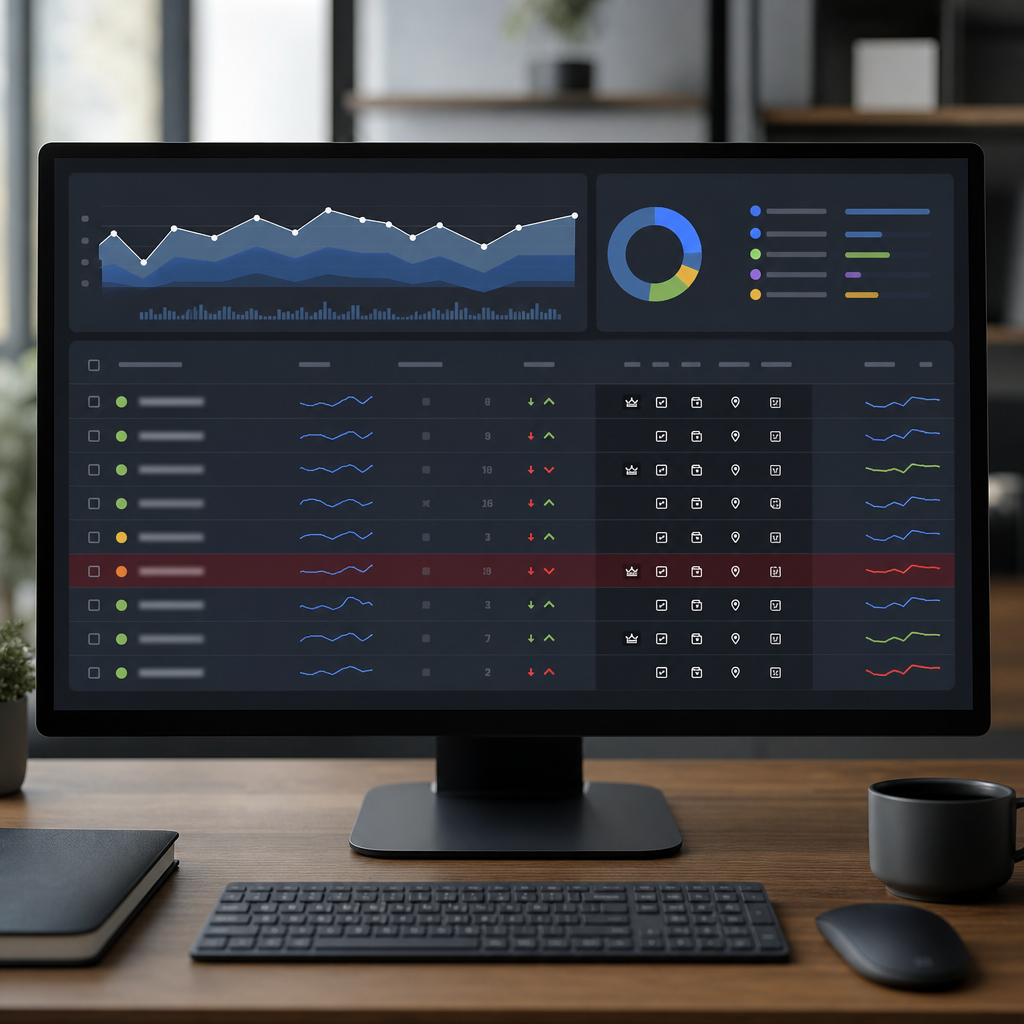
Reality: Relying only on aggregate analytics like sessions and impressions masks the earliest, most actionable signals that indicate whether your SEO work is succeeding or failing. Rank tracking delivers granular position data, SERP feature ownership, device and geo splits, and competitor movement that aggregated tools cannot surface. Teams that skip this end up reactive and wasteful.
Concrete blind spots created by not tracking ranks
- Lost SERP feature ownership: You can appear to hold position while losing a featured snippet or People Also Ask box that steals click volume. A single snippet loss can cut CTR dramatically even if average rank barely changes.
- Local and device divergence: Desktop rankings and mobile rankings can move in opposite directions. Market level drops in a single city will not surface in sitewide metrics until damage is large.
- Competitor hijacks: A new competitor can jump to page one for a handful of high-value keywords and siphon conversions before anyone notices in revenue reports.
- Cannibalization and intent shifts: Multiple pages can compete for the same intent and quietly underperform because intent changed. Aggregate traffic hides which keywords are decaying.
- Timing and volatility blind spots: Weekly or monthly checks miss early drops that are recoverable if acted on in days. Daily noise does exist, but missing the window is costlier.
Practical insight: There is a tradeoff between cadence and noise. Daily rank monitoring gives early warning and supports automated alerts, but it also surfaces false alarms from normal SERP volatility. Use daily checks for alerts, then evaluate movements over a 7 to 14 day window before committing editorial or technical resources.
Limitation to acknowledge: Rank tracking is a necessary signal not a sufficient solution. Position data must be tied to search volume, conversion rate, and page ownership to estimate business impact. Do not treat rank lines as goals in isolation.
Concrete example: A mid market ecommerce site had steady sessions overall while a high value product keyword slipped from position 2 to position 6. Because the keyword drove most conversions for that product category, revenue fell by 18 percent month over month before the team noticed. Daily rank monitoring would have flagged the drop and the loss of a product snippet, enabling a targeted content and backlink response within days.
Real world use case: Use rank monitoring to create a focused action queue. Track 50 to 200 high impact keywords, group them by intent and page owner, set alerts for drops greater than 3 positions or SERP feature loss, and assign a response owner. This converts noisy rank movement into prioritized, measurable tasks.
Teams that skip rank monitoring trade time and control for illusionary calm. Early detection is cheap. Recovery after a missed drop is not.
What Rank Tracking Actually Measures and Why Each Signal Matters
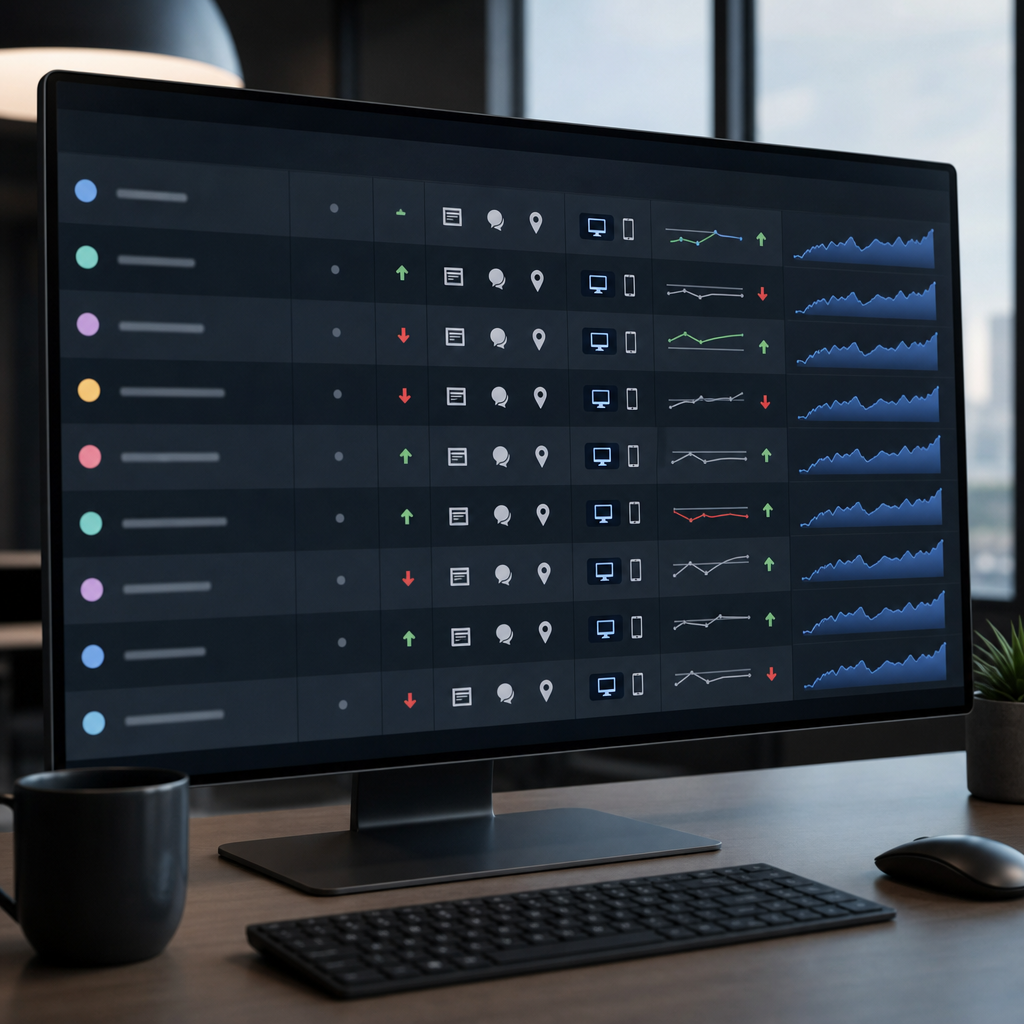
Start here: rank tracking is not just a position list. It records a blend of signals — position, SERP feature presence, device and geo splits, competitor movement, and visibility estimates — and those signals tell you different, actionable stories about why traffic changes will follow or not.
Core signals rank tracking captures
- Position and delta over time: raw rank and sustained movement windows (7/30/90 days) separate signal from daily noise.
- SERP feature presence and ownership: whether a query has a featured snippet, People Also Ask, local pack, images, or video — and whether your page owns any of those.
- Device and location segmentation: desktop vs mobile and city/country-level positions that reveal where optimizations are succeeding or failing.
- Competitor snapshot: which domains are moving up or entering the SERP for your priority keywords.
- Visibility and estimated click share: position-weighted visibility scores and click estimates that map rank to likely traffic, not just rank.
Practical insight: Daily rank updates pick up volatility and immediate competitor moves, but they also raise false alarms. Use daily checks for alerts and a 7–30 day window to decide actions; otherwise you waste editorial and engineering hours chasing noise.
Why each signal matters — and the trade-offs
Position shifts matter — but context is everything. A two-position drop from 2 to 4 can cut clicks sharply for high-volume terms, whereas the same drop on a low-volume informational query may be irrelevant. Prioritize by estimated traffic impact, not raw position change.
SERP features rewrite the click model. Losing a featured snippet or seeing a new video panel can steal clicks even if your average position stays unchanged. That means rank tracking must include SERP feature ownership; tracking position alone misleads teams into thinking visibility is stable.
Geo and device splits create different problems and solutions. Mobile-first ranking drops require different fixes (page speed, UX) than local pack displacement (NAP, reviews, local citations). The trade-off: tracking more segments increases cost and noise, so focus on priority markets and devices first.
Competitor movement is an early warning system. A competitor leapfrogging you often signals new content, a better internal linking strategy, or paid support. When you see systematic competitor gains across related keywords, treat it as a single investigation rather than many isolated fires.
| Signal | What it tells you | Immediate action |
|---|---|---|
| Position drop >3 (sustained 7+ days) | Possible relevance loss, content aging, or competitor improvement | Audit page content, compare top-ranking pages, update title/H1 and top 300 words |
| Loss of featured snippet | SERP feature displacement that reduces clicks despite similar ranking | Test concise answer, structure content for snippet, or rework schema; monitor for 14 days |
| Mobile-only drop | Mobile performance or UX issue | Run mobile speed and Core Web Vitals checks; prioritize mobile-specific fixes |
| Competitor enters top 3 | Competitive content or backlink push | Run competitor content gap and backlink quick-scan; consider targeted content refresh or link outreach |
Concrete example: An ecommerce company tracked a product keyword that remained position 3 overall, but daily rank monitoring revealed a new competitor owning the shopping carousel and a local ads panel appearing for key metros. Estimated click share dropped by an estimated 35 percent in those metros; the team prioritized product feed optimization and local bidding adjustments rather than rewriting the product page.
Next consideration: Start by tracking a focused set of high-value keywords with device and geo splits, combine those signals with estimated click impact, and use alerts for sustained changes. If you want a compact workflow, see how to build a pilot in one week and map alerts to owners in the next section or explore tool options like the Ranklytics top tools guide and the fundamentals of rank tracking in guides from Ahrefs and SEMrush.
Concrete Costs of Flying Blind
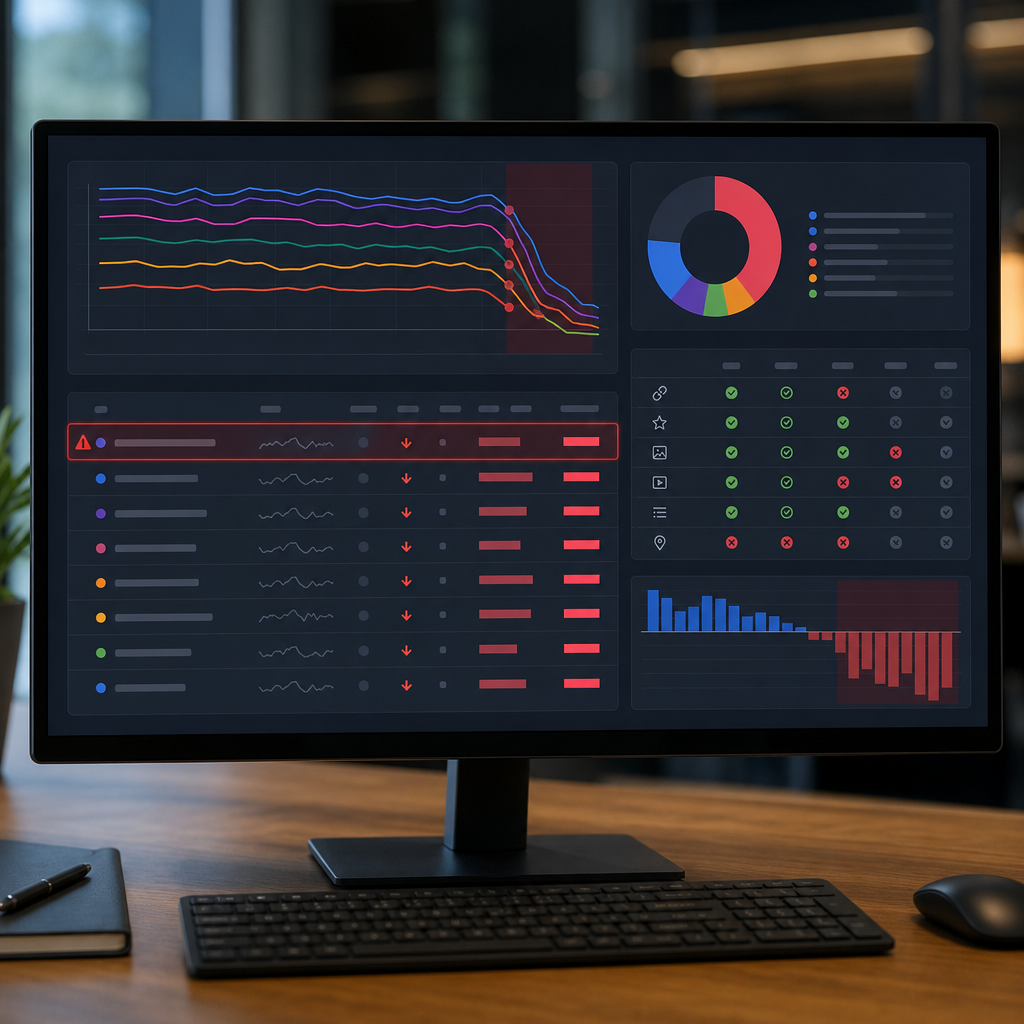
Direct revenue leakage: small, unnoticed shifts in rank or loss of a SERP feature translate to immediate CTR loss and fewer conversions. When a target keyword drops from the top three into the mid-page results or a featured snippet disappears, the traffic impact is magnified because searchers rarely scroll. That traffic loss is real, measurable, and often permanent unless you detect and act quickly.
Wasted editorial budget: without rank tracking you optimize by hunch, not signal. Teams spend time producing long-form content or outreach for pages that were never in a position to win the target intent, while high-potential pages languish. The tradeoff is simple: broad content output looks proactive but yields low ROI if you are not targeting keywords where you already have or can realistically gain position.
Operational and strategic costs
- Slower reaction to competitor moves: competitor rank changes that appear in rankings days earlier than traffic drops give you a head start. Without rank monitoring you only see the symptom in sessions or revenue reports, not the cause.
- Longer recovery windows after algorithm changes: teams that detect ranking volatility early recover faster. Waiting for aggregate traffic dips means you miss the optimal window for small, cheap fixes.
- Bad prioritization and reporting noise: stakeholders ask for position lists or vanity metrics. Without a visibility score and value-weighting, reports encourage chasing low-value wins and create alert fatigue.
- Local and device blindspots: global traffic may look stable while mobile or region-specific rankings crater. That mismatch costs local revenue and undermines campaign performance.
Practical insight and trade-off: daily rank checks catch early signals but generate noise; weekly human review avoids overreaction but delays action. The real-world approach that works is daily automated monitoring plus rule-based alerts for high-impact keywords, then a focused weekly review to assign actions. Use intent and value filters to reduce noise — track fewer keywords more intelligently.
Concrete example: an anonymized SaaS client tracked 60 priority keywords. They lost a featured snippet on a high-intent term and, over three weeks, demo sign-ups tied to that page fell about one-third. Because they had no rank alerts, the drop was only spotted after revenue reports flagged lower MQLs, costing the team extra paid acquisition spend to replace lost leads while they rebuilt organic visibility.
Another real-world use case: a regional retailer assumed stable online foot traffic while the maps pack displaced their listing in one city. Weekly GA sessions looked steady because other markets compensated, but in-store visits in that city dropped. Tracking local rank and the local pack would have revealed the displacement immediately and allowed a fast citation and GMB fix.
| Concrete cost | Business consequence | Immediate mitigation |
|---|---|---|
| Loss of featured snippet or PAA ownership | Sharp CTR and conversion decline on specific pages | Set alerts for SERP feature loss and deploy small content experiments |
| Unnoticed local rank drop | Reduced foot traffic or regional revenue | Track by geo and update local listings; escalate to local owner |
| Misallocated editorial resources | Low ROI content spend | Prioritize keywords by visibility score and conversion value |
If you want to see practical setups for converting these signals into action, review a short workflow for integrating rank alerts with content briefs and owner assignments in our pilot playbook: Top SEO AI Tools and How to Use Them in Your Workflow. For evidence on why position and SERP features matter to CTR, see the analysis at Search Engine Journal.
How to Interpret Rank Movement at a Tactical Level
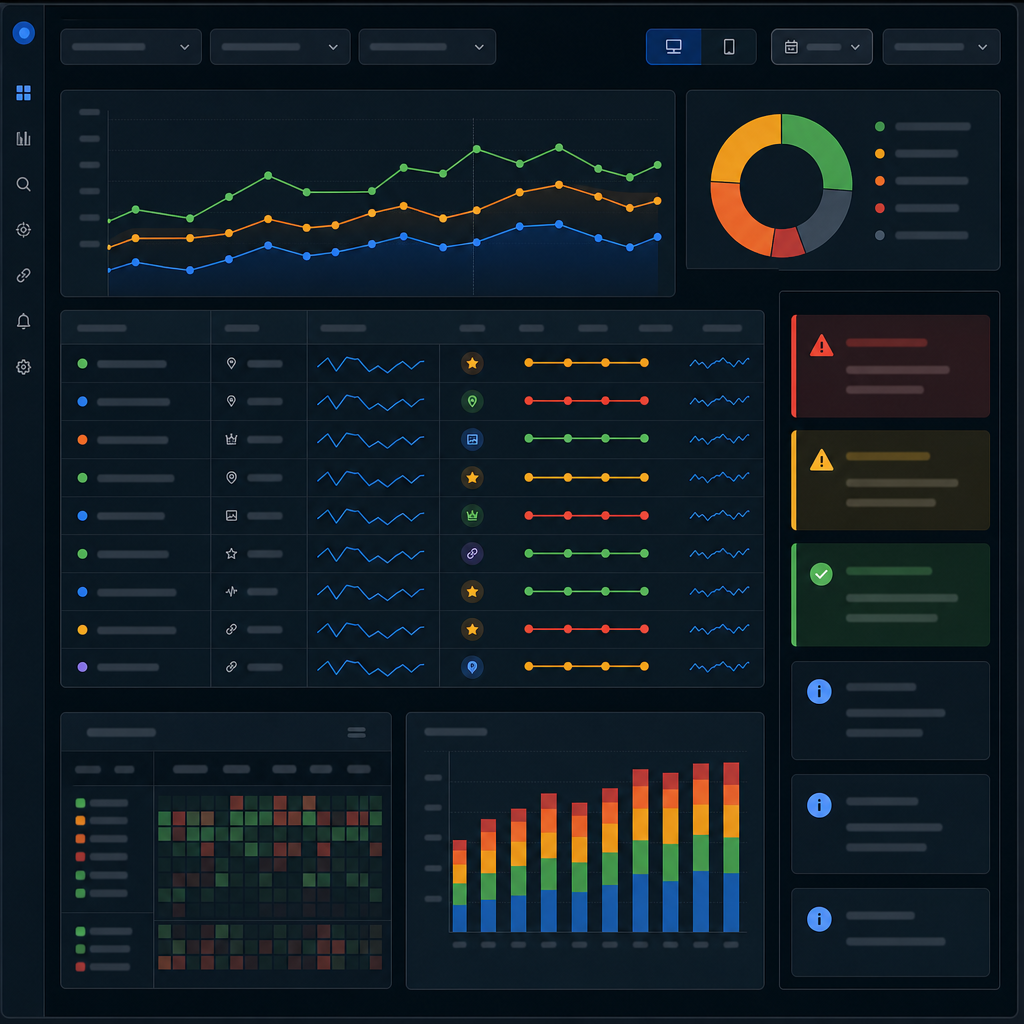
Start with value, not vanity. A single position change is rarely actionable by itself; what matters is the combination of position delta, SERP feature shifts, and the economic value of the keyword. Use rank movement to prioritize work, not to panic.
Signal versus noise: simple rules to stop chasing ghosts
Rule of thumb: treat short-term daily swings as noise unless they cross a value threshold or persist for more than seven days. Daily rank monitoring is necessary to catch emergent problems, but your human review cadence should focus on sustained moves and SERP feature changes.
- Ignore single-day +/-1 position moves for low-value terms.
- Investigate drops of 3+ positions sustained 3–7 days for mid-value terms.
- Act immediately on any loss or gain of SERP features (featured snippet, local pack, People Also Ask) for high-value terms.
Quick diagnostic checklist for a rank drop
- Cross-check impressions and CTR in Search Console to see if visibility actually fell; rank can move without traffic loss if impressions are stable.
- Inspect the SERP for new competitors, ads, or features that now push you down; a featured snippet or shopping carousel can kill clicks even if your position changes little.
- Compare device and location segments — mobile or local drops are common and need targeted fixes.
- Look for content freshness and intent drift — competitor content that better matches intent (tutorial vs buyer guide) is a common cause.
- Validate technical issues only after you rule out SERP and content causes: indexing errors, canonical changes, or accidental noindex do happen, but they are less common than relevance problems.
Practical trade-off: chasing every minor move wastes editorial bandwidth; ignoring SERP feature changes costs far more. Prioritize by expected traffic impact and conversion value, not by how many positions moved.
Mapping patterns to tactical actions
| Observed pattern | Likely cause | Immediate tactical action |
|---|---|---|
| Position falls 4+ and impressions drop | Competitor content or SERP feature displacement | Audit top-ranking pages, update H2s with intent-focused queries, add comparison table or schema, run targeted outreach for links |
| Position drops but impressions steady | Lower CTR due to title/meta or SERP snippet change | Rewrite title/meta to match SERP intent and test with A/B title variants |
| Sudden loss of rankings across many keywords | Indexing or site-level technical problem | Check Search Console errors, recent site changes, and run index coverage report |
Concrete example: A SaaS landing page that historically ranked position 2 for a commercial keyword fell to position 6 after a competitor published a long comparison guide and captured the featured snippet. The team verified impressions dropped in Search Console, updated the landing content to include a structured comparison and a FAQ to target the snippet, and re-prioritized internal linking. Within three weeks the page regained position 3 and recovered much of the lost click volume.
Judgment call many teams miss: automated rank trackers surface dozens of signals; the smart play is to map those signals to a small set of repeatable actions and owners. Without that mapping, rank monitoring becomes noise rather than a decision tool. If you need a template for that mapping, see the one-week workflow in this article and how Ranklytics automates alert-to-action steps.
Next consideration: after you validate a signal as real, pair the tactical action with an experiment and a measurement window so you know whether the update moved both rank and business metrics.
Rank Tracking Metrics That Tie Directly to Business Outcomes
Direct connection: Tracking raw positions is useful, but the metrics that actually map to revenue, leads, or retention are those that convert ranking data into expected clicks and business value. Focus your rank tracking on metrics you can translate into action and dollars.
Metrics to track and why they matter
| Metric | What it signals | Business outcome to watch | Typical action |
|---|---|---|---|
| Visibility score (weighted by position and SERP features) | Aggregate share of SERP attention across target keywords | Changes in organic funnel volume and brand discoverability | Prioritize pages with falling visibility for content refresh or link work |
| Estimated organic clicks per keyword (position × search volume × CTR model) | Leading indicator of traffic change before it appears in GA | Projected visits to revenue-driving pages | Run revenue-at-risk calculations and prioritize high-impact keywords |
| SERP feature ownership (featured snippet, local pack, PAA, knowledge panel) | Whether organic result is even clickable or being displaced | Big shifts in CTR without position change | Target snippet reclamation, structured data, or long-form content |
| Conversion-weighted rank delta (position change × conversion rate of landing page) | Expected change in conversions/revenue from a rank move | Which rank moves matter financially | Focus on rank changes with high conversion lift potential |
| Competitor takeover rate (new competitors entering top N) | Market share shifts on SERPs for priority terms | Risk of sustained traffic loss and pricing pressure | Competitive content audits, backlink gap analysis, or paid defenses |
Practical limitation: Estimated clicks and revenue depend on search volume accuracy and CTR models, which are noisy for low-volume or highly personalized queries. Use these estimates as prioritization signals not absolute forecasts. For low-volume keywords prioritize qualitative signals like intent and pipeline attribution instead of relying solely on numeric estimates.
- Actionable rule: Calculate a simple opportunity score by multiplying monthly search volume × estimated CTR at current position × page conversion rate. Use this to rank remediation tasks.
- Tradeoff to accept: Tracking thousands of keywords inflates noise. Track a focused high-impact set (top 50–200) for revenue calculation, and a secondary bucket for exploratory monitoring.
- Operational insight: Combine SERP feature flags with visibility score. Losing a snippet often reduces clicks more than a one- or two-position drop would imply.
Concrete example: A B2B SaaS team tracked 35 commercial keywords tied to demo landing pages. One keyword retained position 1 but lost the featured snippet; estimated clicks fell by 28 percent and demo requests dropped 22 percent month over month. Because the team had conversion-weighted rank deltas set up, they prioritized a 48-hour content and schema update that recovered the snippet and restored demo volume within three weeks.
Judgment: Position alone is a blunt instrument. Visibility and conversion-weighted metrics are the practical signals that separate busywork from high-impact work. Teams that insist on full keyword breadth without value weighting waste editorial and engineering effort chasing rank noise.
A One-Week Rank Tracking Workflow Teams Can Implement
You can establish a working rank tracking process in seven days that surfaces real signals and forces action. This is not about tracking every keyword you can find — it is about creating a focused, repeatable cadence that filters noise, assigns owners, and ties rank movement to concrete content or investigatory work.
- Day 1 — Define goals and core keyword set. Choose 50–150 keywords mapped to priority pages and commercial intent. Include high-value long-tail terms that currently convert and a handful of high-volume aspirational targets.
- Day 2 — Configure tracking dimensions. Track by device (desktop/mobile), top 2–3 markets, and a 3–5 competitor set per market. Group keywords by topic and funnel stage so alerts are contextual, not raw lists.
- Day 3 — Baseline and visibility score. Run initial scans to capture positions, SERP features, and an estimated visibility score. Export the baseline and save it as the Week 0 snapshot for comparison.
- Day 4 — Define alert rules and thresholds. Set automated alerts for sustained drops (example: >=3 positions for 3 consecutive days), SERP feature loss for owned features, and competitor entries into top 3.
- Day 5 — Assign owners and a weekly review slot. Designate an SEO owner, a content owner, and a product/engineering contact for technical investigations. Schedule a 30–45 minute weekly stand-up to triage alerts and assign tasks.
- Day 6 — Build reporting templates. Create a simple dashboard for stakeholders showing visibility trend, top 10 risers/fallers, and estimated traffic impact. Keep one slide for recommended actions tied to specific keywords.
- Day 7 — Run the loop and adjust. Let daily checks feed alerts for 24 hours, validate a few test alerts manually, then refine thresholds to reduce false positives. Document the workflow and owners in a shared playbook.
Alert rules, thresholds, and the trade-offs you must accept
Practical insight: tighter thresholds catch problems earlier but create more noise; looser thresholds miss fast-moving competitor or algorithm shifts.** My recommendation: start with conservative thresholds (>=3 position move sustained over 3 days or loss of a SERP feature you previously owned) and tighten only if your team can reliably act on every alert.
| Signal | Immediate action (owner + first step) |
|---|---|
| Drop >=3 positions sustained for 3 days | SEO owner: review page intent and on-page; content owner: draft brief for update if intent mismatch |
| Featured snippet or People Also Ask loss | Content owner: assess snippetable content; create a 1-page brief to target the snippet format |
| Competitor enters top 3 for a priority keyword | SEO owner: run competitor SERP snapshot; decide whether to update content or pursue technical fixes |
| Geo-specific drop (one market only) | Local SEO or regional PM: check local listings, citations, and localized content relevance |
Concrete example: A mid-market B2B SaaS tracked 60 priority keywords. On Day 4 an alert fired: one high-intent keyword fell from position 2 to 6 over three days. The SEO owner checked the SERP, found a competitor had added a newer, content-rich comparison, and the content owner pushed a targeted rewrite and comparison table within five days — rank returned to 3 in three weeks and conversion volume recovered. This is the cycle the workflow is meant to create: fast detection, owned response, measurable outcome.
Judgment you should accept: daily rank checks are valuable for early warning, but the human review should be weekly. Teams that manually triage daily noise burn out and ignore alerts. Automate the detection, humanize the response.
If you want a quick pilot, run this workflow on 50 high-value keywords for 30 days, measure signal-to-action time, and expand only when you see consistent ROI.
How Ranklytics Helps Close the Visibility Gap
Direct connection from signal to action. Ranklytics does more than record positions; it automates detection, prioritization, and remediation so teams stop reacting to aggregate traffic dips and start fixing the exact keywords and pages that matter.
What Ranklytics delivers day to day
- Automated daily rank tracking: daily position and delta by device and geo so you catch real movement, not noise.
- SERP feature ownership and alerts: detect loss or gain of featured snippets, local pack flips, and People Also Ask so you respond to traffic-impacting changes fast.
- Competitor snapshots and trendlines: see which domains are encroaching on your keywords and whether their gains are structural or temporary.
- Visibility score and estimated traffic impact: a single metric that weights position, CTR curve, and search volume to prioritize effort where revenue is likely.
- AI-driven content briefs and task handoff: when an alert fires, get a data-backed brief that lists intent shifts, top rivals, suggested content changes, and target keywords for an update.
- Reporting and exports that map to owners: scheduled reports and Slack/email alerts assigned to page owners so signals turn into tracked tasks, not spreadsheets.
| Rank signal | Immediate action | Typical owner |
|---|---|---|
| Featured snippet loss | Generate focused AI brief to regain snippet, test header and schema changes | Content owner or SEO lead |
| Position drop >3 for high-value keyword | Audit page relevance, refresh content, run competitor gap analysis | Content owner + SEO |
| Local pack displacement | Check Google Business listing, local schema, and citation consistency | Local SEO owner |
Practical tradeoff to accept. Automation reduces detection latency but increases the volume of signals; you must pair Ranklytics with a strict ownership model and focused keyword sets. Tracking every possible long tail term creates noise and costs money, so use visibility score to limit the set to high-impact keywords first.
Concrete example: A mid-market SaaS team imported 50 high-value trial-intent keywords, enabled daily mobile and desktop tracking for two priority markets, and set alerts for snippet loss and position drops greater than three. The platform produced an AI brief for a page that lost a snippet; the content owner implemented the brief in a single update. Position and estimated click volume began improving within 10 to 21 days, and the team measured incremental trial signups tied to that keyword.
One hard judgment. Rank tracking only creates a competitive advantage when it is tied to rapid, accountable execution. Tools like Ranklytics provide the signals and even drafts for fixes, but the real differentiator is discipline: tight keyword grouping, owner assignment, and a cadence that forces follow-through. If your team will not commit to that process, rank data becomes noise.
Next consideration: pick the 50 keywords that map to revenue or conversions, map them to pages, and set alert rules before you turn on broad tracking. For a short guide on integrating rank signals into your workflow see Top SEO AI Tools and How to Use Them in Your Workflow.

Written by
ranklytics