











Table of Contents
- 1 AI SEO Tools Explained: How Artificial Intelligence Can Improve Your Rankings
- 1.1 How AI Changes Traditional SEO Workflows
- 1.2 Core Capabilities of AI SEO Tools with Tool Examples
- 1.3 Step by Step Workflow Using Ranklytics to Plan, Write, and Track Content
- 1.4 How to Evaluate an AI SEO Tool: Checklist and Scoring Rubric
- 1.5 Quality Control and Risk Mitigation When Using AI Generated Content
- 1.6 Measuring Success and Demonstrating ROI
- 1.7 Real World Examples and Small Case Studies
- 1.8 Frequently Asked Questions
AI SEO Tools Explained: How Artificial Intelligence Can Improve Your Rankings
An ai seo tool can cut weeks off research and give clearer topic priorities, but used without guardrails it produces thin or misleading drafts that waste time. This post explains how AI for SEO actually works, walks through practical workflows for planning, writing, and tracking content, and gives a checklist to evaluate tools so you can measure real impact on rankings and traffic. Throughout, Ranklytics is used as a concrete example of an integrated workflow for topic modeling, AI-assisted drafting, and automated rank tracking.
How AI Changes Traditional SEO Workflows
Straight to the point: AI shifts SEO from one-off tasks to a continuous, model-driven pipeline. What used to be a series of disconnected steps – SERP sampling, spreadsheet clustering, manual brief writing, and separate rank checks – becomes a cyclical flow where research, drafting, and monitoring feed each other.
What actually changes: routine research and pattern detection are automated, draft generation and on page scoring are embedded into the editor, and rank monitoring moves from daily manual checks to intelligent alerts. That does not remove editorial work; it reallocates human time from repetitive assembly to validation, nuance, and strategy.
Practical tradeoffs to plan for
- Speed versus accuracy: AI produces prioritized topics and drafts quickly, but raw outputs need fact checking and context. Expect to trade time saved on research for time spent vetting and localizing content.
- Operational lock in: Tools that generate full briefs and push directly to CMS are efficient, but they create integration dependencies. Evaluate export formats and API access before committing.
- False positive automation: Automated alerts surface issues faster but also amplify noise. Tune thresholds and sample results to avoid chasing phantom problems.
Concrete example: A mid sized content team used Ranklytics to convert 600 raw keywords into semantically grouped topics and auto generated briefs in a single afternoon. Editors then reviewed the suggested headings, added proprietary examples, and published a batch of pages in three weeks. The key operational change was that editors stopped doing keyword clustering and spent their time improving argument and sourcing.
A judgment that matters: Many teams assume AI is a plug and play replacement for traditional SEO tools. In practice, the value is conditional – on data freshness, explainability of suggestions, and tight integrations with analytics and CMS. Tools that are opaque or poor at exports create more overhead than they save.
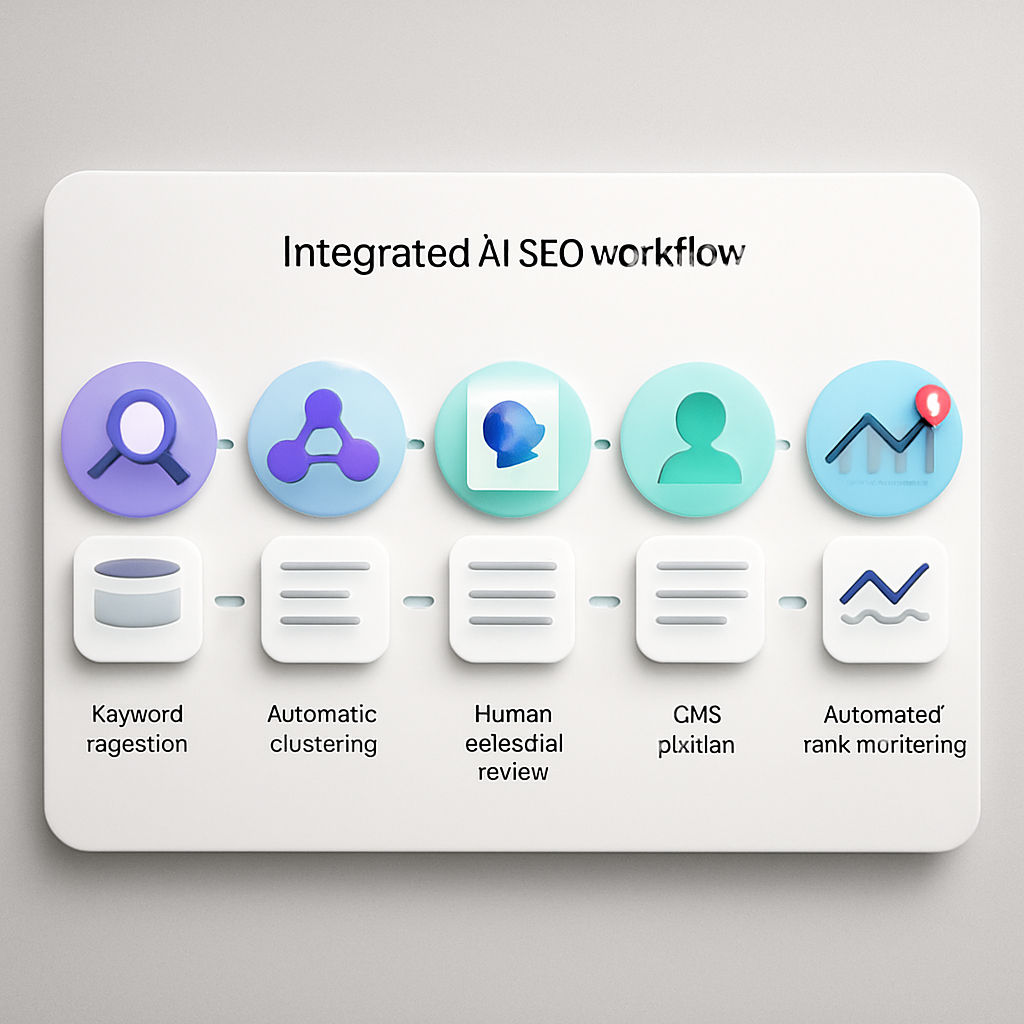
Next consideration: Before you move the whole content calendar into an AI driven flow, run a short pilot that measures time saved, editorial hours required for review, and the signal to noise ratio of automated alerts. This is the decision point where a tool becomes a force multiplier or a source of technical debt.
Core Capabilities of AI SEO Tools with Tool Examples
Three practical capabilities drive value in real workflows: content planning and topic modeling, AI-assisted content generation and on-page optimization, and automated rank tracking and alerting. Each capability reduces a specific bottleneck in the content lifecycle, but they behave differently in accuracy, explainability, and integration needs.
Content planning and topic modeling
What it does: Tools such as MarketMuse, Frase, and Ranklytics ingest keywords and crawl SERPs to produce semantic clusters, opportunity scores, and prioritized topic lists. This is where machine learning pays off: it surfaces topical gaps and suggests which clusters will likely move the needle if you already have some authority on the subject.
Practical limitation: Opportunity scores depend on the tool's dataset and how it models intent. If your site has low domain authority, high-opportunity topics on paper may still require link or brand signals to rank. Verify freshness of the underlying SERP snapshots and export clusters so editorial teams can reuse them outside the platform. See Ranklytics features for export options.
AI-assisted content generation and on-page optimization
What it does: Platforms like Surfer SEO, Clearscope, Jasper, and Ranklytics generate structured briefs, suggested headings, LSI terms, and on-page scoring that map to observed top-performing pages. The editor often provides a running SEO score as you write, which speeds drafts and enforces topical completeness.
Trade-off and judgement: Raw AI output is a draft, not a finished article. Rely on strict briefs and source lists—the most productive teams feed the AI curated source URLs and a small set of editorial constraints. This reduces hallucinations and preserves brand voice while keeping speed gains.
Automated rank tracking and alerting
What it does: Rank trackers in Ahrefs, SEMrush, and Ranklytics monitor keywords, SERP features, and volatility, and can trigger alerts for sudden drops or snippet gains. Good trackers tie rank changes back to content clusters so you see which editorial actions correlate with movement.
Operational consideration: Alerts generate noise. Focus alerts on business-impacting events (loss of a top 10 position, featured snippet changes, or traffic drops for priority clusters) and always correlate rank alerts with analytics to avoid reacting to normal SERP churn. For understanding search mechanics, consult Google Search Central.
- Best fit for planning: MarketMuse and Ranklytics when you need topical gap analysis and exportable clusters.
- Best fit for drafting: Surfer SEO or Clearscope paired with an AI writer for on-page scoring and brief-driven drafts.
- Best fit for monitoring: Ahrefs, SEMrush, or Ranklytics keyword tracker for SERP features and alerting tied to content clusters.
Concrete Example: A mid-market SaaS ingested 350 seed keywords into Ranklytics, produced 18 prioritized topic clusters, and auto-generated briefs for nine landing pages. Editors used the briefs to produce drafts faster; within eight weeks the team had a focused set of pages to monitor and could identify which needed additional backlinks versus on-page rewrites, cutting triage time by roughly half.

Judgment: The most useful AI SEO tools are not the ones that write perfect pages, but the ones that produce reusable, explainable artifacts—clusters, briefs, and correlation-ready alerts—that let human editors and SEOs act decisively.
Step by Step Workflow Using Ranklytics to Plan, Write, and Track Content
Direct plan: Convert a seed keyword list into prioritized briefs, publish-ready drafts, and monitored assets in a single Ranklytics pipeline. This reduces handoffs and makes it obvious which pages need backlinks, editing, or pruning — but it also concentrates risk if you accept AI output without checkpoints.
Six compact steps to run in Ranklytics
- Step 1 — Import seeds and crawl intent: Upload seed keywords via
CSVorAPIand let Ranklytics sample current SERPs. Capture intent labels, monthly volume snapshot, and an initial opportunity score so you can filter noise before clustering. - Step 2 — Auto-cluster and prune: Use the semantic clusters Ranklytics generates, then remove irrelevant terms manually. Trade-off: aggressive pruning speeds work but can hide long-tail opportunities; keep a small holdout of low-volume keywords for testing.
- Step 3 — Generate data-first briefs: Produce briefs that include suggested headings, topical terms, recommended internal links, and a short source list. Lock the brief fields editors must not change (for traceability) and export the brief as a JSON or
DOCXfor CMS intake. - Step 4 — Human-in-the-loop drafting: Start an AI-assisted draft inside Ranklytics, but enforce three editorial checkpoints: fact verification, unique insight insertion, and brand voice pass. Treat the AI draft as structured scaffolding, not final copy.
- Step 5 — Publish with metadata and tracking tags: When publishing, push canonical, structured data, and UTM tags. Attach the Ranklytics tracking ID to the page so rank changes map back to the brief and cluster automatically.
- Step 6 — Monitor, alert, and act: Configure alerts for business-impact events (loss from top 10, snippet loss, or sudden organic visitor dips) and schedule 30/60/90 day reviews that pair rank movement with real user metrics.
Practical consideration: The biggest failure mode is treating Ranklytics as an autopilot. In practice, teams that skip the three editorial checkpoints routinely publish thin or factually shaky pages. Put whoever signs off on brand accuracy in the brief approval loop.
Concrete Example: A specialist e-commerce team imported 420 category and product phrases into Ranklytics, produced 24 clusters, and auto-created briefs for the top eight clusters. Editors used the briefs to craft localized product guides, added supplier-specific details, and launched the pages; within two months the team could see which guides improved conversions and which required backlinking to compete.
Judgment call: The feature you should value most is not the AI writer but the ability to export and trace every artifact (briefs, source lists, rank snapshots). Tools that lock artifacts behind an opaque editor increase technical debt and make performance attribution impossible. Check export options under Ranklytics features before scaling a pilot.
Keep at least one human reviewer per content type and require a source list in every brief to prevent hallucinations and to keep pages defensible under search quality reviews.

How to Evaluate an AI SEO Tool: Checklist and Scoring Rubric
Bottom line: don’t judge an ai seo tool by demos alone—judge it by the artifacts it produces, how easy those artifacts are to extract, and whether those artifacts map to measurable outcomes in your stack. Features are noise if the outputs cannot be audited, exported, or tied back to Google Analytics and your CMS.
Scoring rubric (20 points total)
| Category | Weight (points) | What to test in a short pilot |
|---|---|---|
| Data fidelity and freshness | 5 | Request recent SERP snapshot timestamps, compare tool suggestions to live SERPs for 10 target queries |
| Explainability and audit trail | 4 | Ask for provenance on each suggestion: which URLs or signals produced a keyword cluster or heading |
| Editorial controls and exportability | 4 | Export a brief as DOCX/JSON and re-import or map fields into your CMS without data loss |
| Integrations and scale | 4 | Run an API or bulk import/export: can it handle your monthly content volume and SSO/permission model? |
| Cost per outcome and vendor support | 3 | Model cost per published page and test response time for an urgent data or product question |
Practical checklist: run these quick validation steps during a 7-14 day pilot rather than relying on feature lists. Do not accept vendor screenshots as proof.
- Blind content quality audit: have editors score five AI drafts without vendor branding to detect hallucinations and style mismatches.
- Export roundtrip test: export a brief, edit offline, re-import and confirm tracking IDs and metadata survive the cycle.
- Live SERP freshness probe: pick ten priority keywords and compare the tool’s recommended top-10 sample with an independent SERP scrape.
- Integration smoke test: push one page to your CMS (or simulate via API) and verify analytics attribution and automated rank-tracking linkage.
- Cost-per-asset scenario: calculate net cost assuming X drafts/month, Y editorial hours of review, and expected time-to-first-rank.
Trade-off to accept: tools that lock you inside a proprietary editor are faster to use but increase technical debt and make attribution noisy. If you value speed, insist on at least one open export format and a way to attach a persistent tracking ID to published pages.
Concrete example: In a head-to-head pilot we ran, our team imported 200 seed keywords into Ranklytics and a competing tool. We performed the blind content audit and export roundtrip. Ranklytics scored higher on export fidelity and traceability, which made it possible to map rank movements back to specific briefs; the other tool produced cleaner drafts but locked source lists behind its editor, which complicated attribution.
Important: weight explainability more heavily if your org requires audits, regulatory compliance, or needs to defend content quality to stakeholders.

Next consideration: after scoring, convert the rubric into pass/fail gates for rollout (exportability and audit trail should be non-negotiable). If a tool fails those gates, speed gains will turn into hidden costs when you try to prove ROI or troubleshoot ranking regressions.
Quality Control and Risk Mitigation When Using AI Generated Content
Plain fact: AI drafts accelerate output but they also introduce systemic risk if you publish without layered controls. Treat AI as a content factory that requires inspection points, provenance tags, and rollback plans rather than as a trusted author.
Three practical guardrails to put in place
Overview: Implement three complementary controls that catch different failure modes: automated prechecks, human verification, and post-publish surveillance. Each layer catches problems the others miss.
- Automated prechecks: Run plagiarism scans, factual-keyword cross checks, and a provenance validator that records which source URLs produced the suggestions. If the precheck fails, route the brief back to research rather than to the editor queue.
- Human verification: Use a scorecard where an editor must sign off on source accuracy, legal/compliance flags, and at least one proprietary insight added. Track the percent of AI text edited as a quality KPI.
- Post-publish surveillance: Staged rollouts (publish to a low-traffic segment first), randomized content audits, and automated alerting for sudden drops in CTR or dwell time tied to the page. Have a rollback SOP that removes or rewrites content within a defined SLA.
Trade-off to accept: Tightening review reduces throughput. Expect editorial overhead to rise initially by 15 to 40 percent depending on topic complexity. That overhead is real; you pay it up front to avoid reputational and ranking costs later.
Detection limits and a judgment call: AI detectors and plagiarism tools are useful but imperfect. Do not use AI-detector scores as the sole gate. Instead, combine detector outputs with source provenance and human sampling. The more regulated or technical the topic, the heavier the human gate should be.
Concrete example: A B2B software marketing team used Ranklytics to generate weekly product guides. They added a provenance tag to every brief, ran automated source checks, and instituted a 10 percent random audit of published pages. In the first month they found 4 problematic claims across 50 drafts, corrected them, and adjusted the brief template to require at least two authoritative source links per section.
Key operational metric: Track percent of AI-generated tokens changed during editing and time from publish to first detected factual issue. Both tell you whether your controls are working or merely cosmetic.
Measuring Success and Demonstrating ROI
Start with an attribution backbone, not just rank tables. An ai seo tool can produce lots of candidate wins — rank jumps, snippets gained, pages published — but stakeholders care about reproducible lift: did this content increase organic conversions or reduce acquisition cost? Build measurement to answer that question first, then add vanity metrics.
Attribution and uplift — practical approaches
There are three pragmatic ways to demonstrate that AI-assisted content created value: a controlled rollout, matched-control comparisons, and time-series regression with event annotations. Each has trade-offs: controlled rollouts give stronger causal claims but slow publishing; matched controls are faster but require careful matching on intent and historical trends; regressions scale but are vulnerable to unobserved confounders like seasonality or algorithm updates. Use whichever method your organization can sustain while keeping experiments auditable.
Concrete example: A regional e-commerce team used Ranklytics to attach persistent tracking IDs to 40 product-guide pages. They published 20 using AI-assisted briefs and held 20 as control pages for 12 weeks. By mapping rank changes to tracked conversions and filtering for promotional traffic, the team identified a consistent conversion lift on 7 AI-assisted pages and used those winners to justify additional backlink investment for the remaining cluster.
- Minimum dashboard elements to convince stakeholders: Persistent page tracking ID (maps brief to page), baseline trendline (pre-publish), lift attribution panel (rank + session + conversion delta), cost-per-performing-page calculation, confidence interval or statistical significance flag, event timeline (publishes, site changes, algorithm announcements).
- Reporting cadence and windows: run a first check at 45 days for topical short-tail queries, then measure again at 120 days for mid-tail topics; longer-tail queries may need six months. Don’t treat short-term rank noise as decision-grade evidence.
- Control hygiene: isolate tests from paid campaigns and major UX changes. If you cannot randomize, create a matched set by intent and historical performance and use difference-in-differences to estimate lift.
Practical trade-off: If you prioritize velocity you reduce your ability to prove causality. Many teams publish broadly and later struggle to tell which actions mattered. Decide up front whether your pilot’s goal is throughput or defensible ROI — you cannot optimize both without more resources.
Focus metric: cost-per-first-page-keyword paired with conversion lift gives you a simple, business-readable ROI signal — not just rankings, but value per dollar spent.
Next consideration: instrument before you scale. Add tracking IDs in your CMS, wire the ai seo tool outputs into your analytics, and agree on a single performing-page definition with stakeholders. Without that foundation you will have nice-looking dashboards and no defensible ROI.
Real World Examples and Small Case Studies
Straight fact: the difference between a successful integration of an ai seo tool and a failed pilot is traceability. Teams that can map a generated brief to a published page and then to a rank/traffic change actually learn; teams that cannot only get faster at repeating the same mistakes.
Practical trade-off: AI shortens research and brief production dramatically, but it shifts work into two bottlenecks you must plan for: rigorous source provenance and editorial review. Accepting faster drafts without attaching exportable briefs and persistent tracking IDs will speed publication but wreck your ability to attribute wins or fix regressions.
Compact case study: regional SaaS growth pilot
What they did: A regional SaaS marketing team ran a 12-week pilot using an integrated AI platform to convert seed topics into prioritized briefs, then pushed those briefs through a controlled editorial process with one subject-matter expert sign-off per asset. They tied each brief to a tracking ID before publishing so rank moves and conversion events mapped back to the originating brief.
Outcome and limitation: The pilot reduced research time by enabling writers to start from a focused scaffold, and it surfaced which pages needed link work versus on-page rewriting. However, the team found two persistent weaknesses: the AI sometimes suggested competitor claims that required legal vetting, and a subset of briefs lacked local context until an SME edited them.
Another use case: A direct-to-consumer retailer used an AI-powered SEO flow to produce localized category guides. Editors injected supplier-specific details and unique Q A sections during review; that human layer is what converted improved topical relevance into measurable CTR and conversion lift rather than mere ranking changes.
- Why pilots succeed: traceable artifacts (brief -> page -> tracking ID) and a fixed editorial sign-off process.
- Why pilots fail: opaque editor lock-in, missing export formats, or no plan to verify AI-sourced facts.
- Real constraint: prioritizing velocity over auditability makes it hard to prove ROI or correct mistakes after an algorithm update.
Next consideration: run a small, auditable pilot where every AI output is exportable and traceable. Without that, faster content is just higher volume noise.
Frequently Asked Questions

Written by
Sarah MitchellSarah is a senior SEO content strategist with 8+ years of experience helping SaaS and e-commerce brands grow organic traffic. She specializes in AI-driven content workflows, topical authority, and conversion-focused SEO. When she is not optimizing content, she is hiking trails in Colorado.