











Table of Contents
- 1 SEO AI Tools: The Best AI Features That Accelerate Keyword Research and Content Creation
- 1.1 AI driven keyword discovery and intent clustering
- 1.2 Automated content briefs and outline generation
- 1.3 Context aware drafting and rewrite features
- 1.4 SERP signal analysis and competitor synthesis
- 1.5 Automated meta, title and schema optimization
- 1.6 Content performance forecasting and rank tracking
- 1.7 Example workflows: from seed keyword to published article using Ranklytics
- 1.8 Measuring impact and governance for AI generated content
SEO AI Tools: The Best AI Features That Accelerate Keyword Research and Content Creation
If your content team is stretched and you need faster, higher-quality output, seo ai tools can deliver — but only when you use the right features the right way. This post breaks down the highest-impact capabilities — semantic clustering, automated briefs, context-aware drafting, SERP synthesis, and forecasting — shows how they work in real platforms like Ranklytics, Semrush, and Ahrefs, and gives step-by-step workflows to move from seed keyword to published article with integrated rank tracking. I also call out common failure modes and the validation metrics you must track to turn AI time savings into real ranking gains.
AI driven keyword discovery and intent clustering
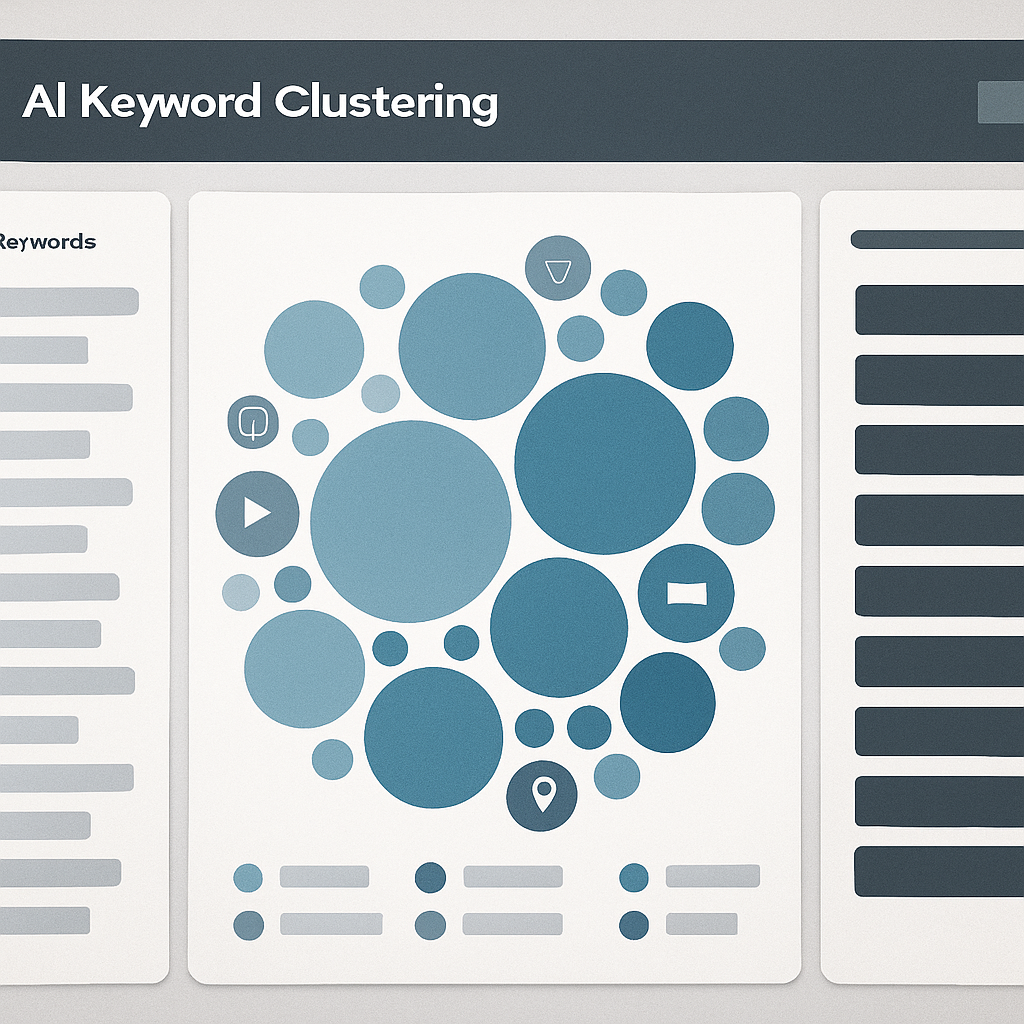
Straight to the point: using embeddings and semantic matching to build intent clusters is the single fastest way to turn a handful of seed terms into an actionable editorial plan that aligns with real user intent.
What it does: AI-driven keyword discovery expands a seed like remote work tools into hundreds of related queries, then groups them by intent (informational, transactional, comparison, navigational) using vector similarity rather than keyword text matching. That matters because search engines now reward topical coverage, not isolated keyword stuffing.
Quick seed-to-cluster workflow
- Seed and expand: start with 3–5 high-level seeds and pull suggestions from
Ahrefs/Semrushand an embeddings API inside Ranklytics to surface long-tail variants. - Embed and cluster: convert phrases to vectors, run nearest-neighbour clustering, and label clusters by dominant intent using SERP feature signals.
- Prioritize: score clusters by organic traffic potential, ranking difficulty, and strategic fit (brand goals or product funnel).
- Human validate: sample 10% of cluster members to verify intent labels and remove off-topic terms before drafting.
Practical trade-off: embeddings reveal semantic opportunities that plain keyword lists miss, but they can over-associate uncommon phrases if the similarity threshold is too loose. In practice you must balance cluster granularity: too coarse and you lose actionable topics, too fine and you create dozens of tiny articles that cannibalize each other.
Concrete example: a SaaS content team seeded remote work tools. AI expansion returned 420 phrases; clustering produced three clear groups: product comparisons, setup guides, and productivity workflows. Using Ranklytics automated clusters, they prioritized a comparison cluster with 12 high-intent long tails and published a 1,500-word comparison that began ranking on page one for two target phrases within six weeks.
What works in practice: combine AI clustering with SERP analysis — look at top result intent, featured snippets, and People Also Ask — not just similarity scores. Tools that merge embeddings with live SERP signals (for example Ranklytics and Semrush) give intent labels that reflect current ranking behavior, which is what drives traffic.
Common misjudgment: teams often treat clustered lists as final topic definitions. They are not. Clusters are starting points that should be converted into editorial briefs with specified audience, expected questions to answer, and target internal links. Skip that step and you waste the time the AI saved.
Measurement: track number of new long-tail keywords added, time from seed to prioritized topic (goal: under 2 hours per topic), and early CTR/impression lifts for the top 10 clustered keywords over 30 days. Also note that 60% of marketers expect AI to be crucial to SEO strategy within five years — treat clustering capability as a procurement filter when evaluating AI SEO tools (HubSpot).
Automated content briefs and outline generation
Direct point: Automated briefs shrink the research-to-outline step dramatically, but they succeed only when the AI combines SERP signal synthesis with explicit editorial constraints. Tools that feed top-ranking snippets, People Also Ask, and competitor headings into a brief produce outlines editors can use immediately — pure generative outlines without SERP grounding rarely do.
What the feature actually does: AI content briefs typically pull three inputs — SERP structure, competitor content, and keyword clusters — then output a prioritized outline with intent labels, suggested word counts, target keywords per section, and a short list of sources to cite. MarketMuse, SurferSEO, and Ranklytics implement variants of this; the difference that matters is whether the brief exposes its signals (which pages it scraped, which queries shaped the headings) so an editor can validate quickly.
Practical trade-offs and limits
Trade-off: You gain speed at the cost of nuance. Briefs are excellent for structure and intent alignment but poor at surface-level fact accuracy and bespoke messaging. Limit editorial risk by treating the brief as a scaffold, not the final copy. Also watch word count suggestions — AI often inflates counts to match perceived topical depth rather than actual user intent.
Concrete example: For the target keyword best project management software for remote teams, generate a 7-heading outline with intent labels and two suggested sources per heading. A usable prompt looks like: `Produce 7 headings for
Context aware drafting and rewrite features
Key point: Context aware drafting and rewrite features turn an AI from a generic generator into a task-specific writer by feeding it the brief, SERP signals, and site context before it composes anything — that is the difference between a usable draft and scrap work.
What it does: These features ingest structured inputs (topic cluster, target URL, example paragraphs, tone rules, and internal linking map) and produce section-level drafts or rewrites that respect intent and on-page constraints. Tools that do this well include Jasper long form assistant, platform integrations of OpenAI GPT, and Ranklytics AI writing assistant which can accept a Ranklytics brief and the target page as context.
Practical limitation: Models are limited by context window size and by the quality of the brief. Large pages need chunking; when you rewrite whole articles in one pass the AI often loses global argument flow or repeats points. Rewrites can also drift toward over-optimized phrasing if you supply heavy keyword lists without explicit style constraints.
Two short prompts you can use now
Draft prompt: Write a 300-word section titled Benefits of using TARGET_KEYWORD aimed at mid-market SaaS product managers. Use a professional but concise tone, include 3 short subpoints, insert 1 internal link to the product pricing page using the anchor text pricing, and end with a one-line CTA. Use the brief: headings = [bullet list], must include concept X from the brief, target keyword = TARGET_KEYWORD.
Revision prompt: Revise the above to add one credible statistic with source and convert two passive sentences to active voice; highlight any factual claims that need verification and list suggested internal pages for additional links.
Concrete example: A content team used Ranklytics to generate the benefits section for a SaaS features page. The AI produced a usable 300-word draft in 6 minutes; the editor spent 18 minutes adding a sourced statistic, swapping one paragraph for a customer quote, and inserting two internal links — total time to publish-ready section 24 minutes instead of roughly 90 minutes manual.
- Checks to enforce: require the AI to return sources for any numeric claim, run a plagiarism check, and compare suggested internal links to a canonical internal linking list.
- Style guardrails: provide 2–3 sample paragraphs that exemplify brand voice and require the AI to match sentence length and vocabulary range.
- When not to use full auto-rewrite: avoid one-pass rewrites for high-stakes pages (legal, medical, or pricing guarantees) — use AI for outlines and first-pass wording only.
Judgment call: In practice, context-aware drafts work best when you standardize the brief and measure the edit burden. If your editors consistently make the same two edits (fixing stats, adding links), automate prompts to ask the model to include those items up front; if edits are wide-ranging, the model is being used beyond its reliable scope.
Use AI for speed; use editorial gates for accuracy. The most productive teams treat the AI as a structured junior writer, not a final author.
Next consideration: Add an edit-gate to your publishing workflow that measures time saved and the percentage of AI claims needing verification before you scale automated drafting across many pages (see Google Search Central for helpful-content guidance).

SERP signal analysis and competitor synthesis
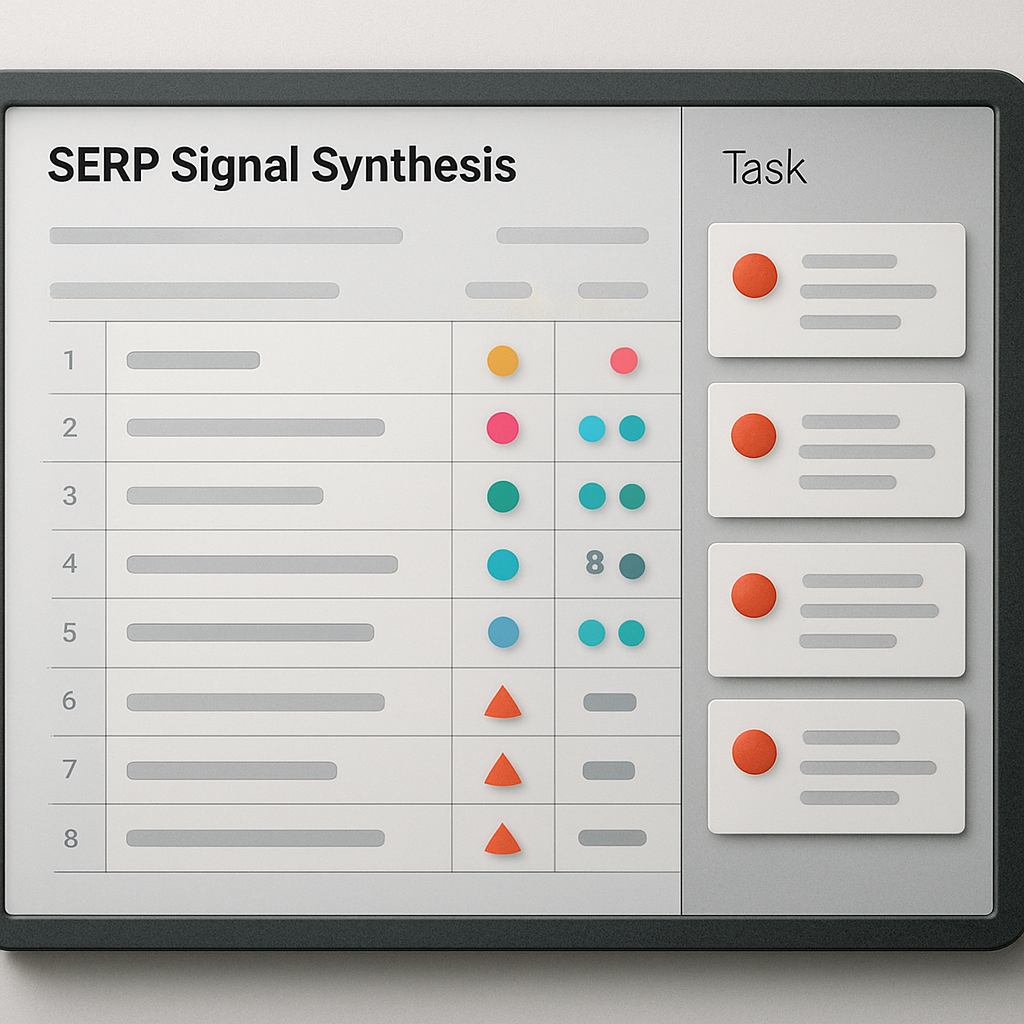
Direct point: the single biggest value AI brings to SERP analysis is turning scattered SERP signals into prescriptive edits you can assign to writers and engineers. Raw lists of top URLs are noise; good AI extracts what the SERP rewards right now — featured snippets, People Also Ask, common headings, media types, and backlink density — then proposes specific content gaps to close.
What smart SERP synthesis actually looks like
How it differs from naive scraping: modern AI-driven tools combine DOM scraping with signal layers: SERP feature presence, top page word counts, header structure, schema types, and backlink metrics from Ahrefs or Semrush. Systems like Ranklytics and Clearscope then use NLP and embeddings to summarize recurring subtopics and surface missing elements — not just repeated phrases.
- Actionable signal: lack of a pricing table on top pages = opportunity to add comparative pricing (improves CTR and snippet odds).
- Actionable signal: multiple top results answer the same 3 PAA questions — include those Q A blocks verbatim in the brief to target PAA and featured snippet slots.
- Actionable signal: top pages rely on outdated stats or no primary data — add an original chart or small study to differentiate and earn links.
Trade-off to accept: deeper SERP synthesis slows initial ideation. If you want speed, you can generate a draft in minutes; if you want sustainable ranking, add 30–90 minutes of SERP signal extraction and competitor synthesis. In practice, that extra time reduces rewrite cycles and speeds time-to-rank.
Limitation and guardrail: AI summaries imitate the language of top pages and can accidentally reproduce structure or claims. Always run a originality check, and require the AI to cite sources when summarizing competitor facts — otherwise you risk subtle plagiarism or factual drift. For guidance on what Google expects from helpful content, see Google Search Central.
Concrete example: For the query best project management software for startups, Ranklytics synthesizes the top 10 pages and flags three gaps: missing startup-specific pricing comparisons, no customer case study section, and no quick decision matrix image. The brief then turns those gaps into tasks: add a pricing comparison table, a one-paragraph startup case study with a sourced metric, and a 3×3 decision matrix image — each mapped to who owns it and expected impact on CTR and linkability.
Prioritize actions that capture SERP features (PAA, snippets, tables, images) before cosmetic copy changes — these moves drive better ranking velocity than keyword rephrasing alone.
Automated meta, title and schema optimization
Practical point: AI features that generate meta titles, descriptions, and JSON-LD schema matter because the marginal gains are immediate and measurable — small CTR improvements compound across dozens or hundreds of pages. Use AI here for scale and variation, not to replace editorial judgment.
How it works: AI-powered tools such as Semrush SEO Writing Assistant and Ranklytics can produce multiple title and description variants tuned to different intents (informational, transactional, navigational) and can auto-fill schema blocks by mapping page elements to schema.org types. The generators extract headings, H1, key facts, product attributes, and FAQs, then produce Article, Product, FAQPage, or HowTo JSON-LD snippets.
Tradeoffs and common failure modes
Limitation: Automated meta text can over-optimize for keywords or promise things the content does not deliver, which increases pogo-sticking and can reduce rankings. AI-generated schema often hallucinates fields like ratings, publish dates, or pricing when those values are not present in the CMS. Always source schema values from authoritative fields in your CMS or a verified product feed.
Judgment: Use AI to propose variants and to auto-generate boilerplate schema, but gate changes through a validation step: confirm factual fields, ensure the meta matches on-page intent, and run schema through the Rich Results Test before deploy.
Concrete example: A SaaS content team used Ranklytics meta generator to create five title/description pairs for a how-to guide. They deployed two variants across similar low-traffic pages and tracked CTR and impressions via Ranklytics and Google Search Console for 21 days. One variant produced a 28% lift in CTR and an improved average position; the team kept that pattern and rolled the format to 120 pages, yielding a measurable traffic increase in 90 days.
- A/B testing approach: Deploy one variant to a sample of comparable pages, measure CTR and impressions for 2–4 weeks, then roll winners at scale using Ranklytics or your CMS.
- Schema checklist: Map essential fields from CMS -> schema, avoid generated claims (ratings, prices) unless sourced, validate with Rich Results Test.
- Length & intent rule: Prefer natural language that matches user intent over dense keyword lists; a concise, accurate meta that reflects content performs better than keyword-stuffed variants.
| Schema type | When to use |
|---|---|
| FAQPage | Use for pages that directly answer discrete questions; auto-generate only from verified Q&A blocks on the page |
| HowTo | Use for step-based tutorials with explicit steps and materials listed in the content |
| Product | Use for ecommerce pages with canonical pricing and inventory data sourced from your product feed |
| Article | Use for blog posts; ensure author and publishDate are accurate and present in CMS |
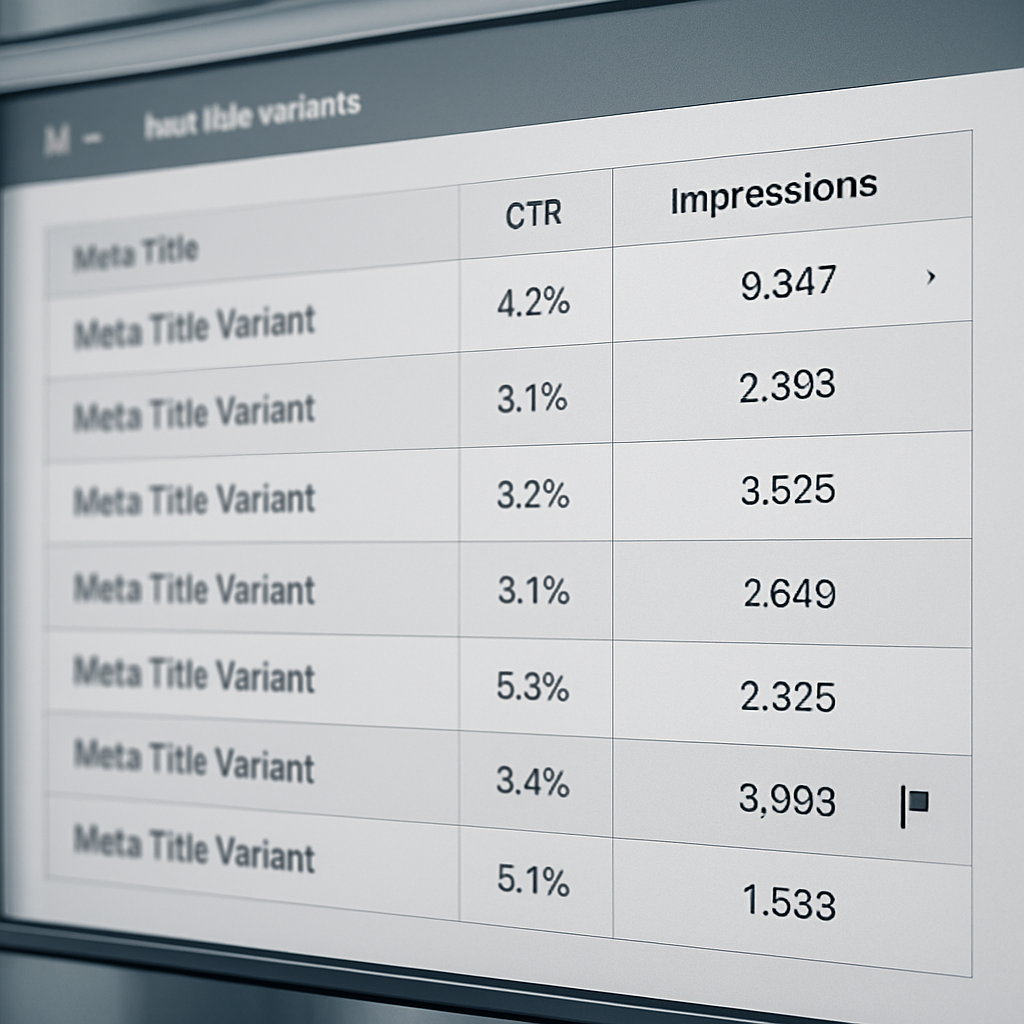
Next consideration: Build this into your publishing checklist: generate variants with AI, validate schema values from CMS, run a short A/B window, then scale winners. Track CTR, impressions, and pogo-sticking; if CTR rises but engagement drops, revert and iterate on the meta to better match on-page content.
Content performance forecasting and rank tracking
Forecasts are not crystal balls — they are prioritization tools. Use predictive models in seo ai tools to separate effort that will likely move the needle in weeks from work that builds authority over months.
How forecasts work and what they actually predict
Core signal set: modern AI-driven SEO tools combine historical rank trajectories, SERP volatility, estimated search volume, CTR curves, and competitor behavior to produce a short-term ranking probability and an expected traffic range. Vendors call this Traffic Potential, Opportunity Score, or Ranking Velocity.
What they reliably give you: a relative score for prioritization and a plausible traffic range. They are good at saying which of two topics is more likely to produce impact quickly. They are poor at precise daily traffic predictions because of seasonality, personalization, and Google algorithm updates.
Practical use and a simple workflow
- Baseline the page: record current rank, impressions, and clicks in a tracking tool the day you publish or update – use
Ranklyticsor Google Search Console for the baseline. - Prioritize by expected return: rank keywords by predicted traffic delta and time-to-rank. Favor pieces with high expected delta and short predicted horizon for fast wins.
- Set measurement windows: evaluate movement at 30, 60, and 90 days and compare actuals to forecast ranges.
- Tag and attribute: attach tracked keywords to the content item so rank history and on-page changes are visible in one timeline.
- Adjust plan: if actuals miss forecast consistently, lower the model weight and invest in link building or content depth instead.
Concrete example: a SaaS content team uses Ranklytics to forecast three post ideas. One shows high short-term potential for a long tail question with low SERP competition; the team publishes it and sets a 30 day check. The post moves into top 5 within 28 days, validating the model; the team reallocated next week of effort from a low-probability pillar piece into another quick-win.
Limitation and trade-off: forecasts favor low-hanging, easy-to-rank queries. If you optimize solely on predicted short-term gains you risk starving pillar content that builds topical authority. Balance the backlog: use forecasts to schedule quick wins while protecting runway for strategic pages that need links and time to mature.
Validation, governance, and avoiding common mistakes
Do the forecast experiment and log the error. Run a rolling A/B of predicted vs actual outcomes across 20 published pages and record bias and variance by 30/90 days. That error profile tells you how much to trust the model for planning.
| Horizon | Primary use |
|---|---|
| 30 days | Validate quick wins, measure ranking velocity, early CTR signals |
| 60 days | Assess content resonance and initial topical authority |
| 90 days | Decide on amplification: link outreach, refresh, or retire |
Ranklytics or add Google Search Console data to reduce blind spots. See Google Search Central for signal guidance and Semrush AI SEO for how vendors present traffic potential.Example workflows: from seed keyword to published article using Ranklytics
Direct claim: You can move from a seed keyword to a published, monitored article in under 48 hours for low-competition long-tail topics using Ranklytics, and in 4–12 weeks for high-value pillar content—if you follow a strict, editorialized workflow.
Rapid workflow (48 hours) — when to use it
When this works: Use for narrow intent queries with low SERP competition where domain authority and backlinks are not the limiting factors. Trade-off: speed over depth; expect faster indexation but smaller initial traffic gains.
- Hour 0–1: Seed and cluster. Input a seed like
best onboarding software for small startupsinto Ranklytics clustering to get 30–50 long-tail variations and an intent cluster. - Hour 1–2: Brief generation. Use Ranklytics AI brief to pull SERP snippets, PAA questions, and a 6–8 heading outline with suggested word counts and target keywords.
- Hour 2–6: Draft with AI. Feed the brief into Ranklytics writing assistant with this prompt:
Draft a 600–800 word guide for startup founders on choosing onboarding software. Use the headings from the brief, include at least two practical examples, and insert one internal link to our /product-page. - Hour 6–12: Human edit and fact-check. Verify any statistics, add citations, enforce brand voice, and run a plagiarism check.
- Hour 12–24: Meta, schema, and publish. Generate 3 meta variants in Ranklytics, add FAQ schema for PAA items, publish and snapshot baseline rank positions.
- Day 2: Set tracking and review. Activate integrated rank tracking and set 30/60/90 day review tasks.
Concrete example: A SaaS marketing team used this flow for the seed affordable onboarding software and published in 36 hours; the page gained first-page impressions for multiple long-tail phrases within three weeks and converted at 0.9%—not blockbuster, but valuable incremental traffic with minimal editorial cost.
Pillar workflow (4–12 weeks) — when depth matters
When to choose this: Use for competitive, high-volume topics where topical authority, backlinks, and content depth determine ranking. Limitations: this workflow requires outreach for links and iterative updates; you trade speed for durability and traffic potential.
- Week 0: SERP synthesis. Run Ranklytics competitor synthesis, export gap items, and augment with Ahrefs for backlink and volume signals.
- Week 1: Research + brief. Create an expanded brief with data tables, sources to cite, and a content architecture for a pillar plus cluster pages.
- Week 2–3: Draft + expert review. Use Ranklytics AI to draft sections, then have subject matter experts validate claims and add original data or quotes.
- Week 4–8: Publish, promote, and link building. Publish the pillar, promote to outreach targets, and secure at least 3–5 contextual links before expecting major rank movement.
- Week 8–12: Monitor and iterate. Use Ranklytics forecasting and rank tracking; update the brief and article based on ranking velocity and user engagement signals.
Prompt example for revision: Revise section 3 to include two authoritative citations (one from a vendor, one from a study), add a data table summarizing features, and bold the product comparison rows. Use this after the AI draft to reduce hallucination and enforce source discipline.
Important: fast workflows amplify hallucination risk. Always require a human fact-check step and record sources in the brief before publish.
Checklist before hitting publish: Fact-check statistics, add at least two internal links to relevant pages, validate schema markup, choose meta variant for initial A/B test, and start Ranklytics rank tracking with a baseline snapshot. See why audits fail for common pitfalls in rushed audits.
Takeaway: Use the rapid workflow when the goal is predictable, low-friction wins; use the pillar workflow when competition and value justify extra research and outreach. Next consideration: decide whether a page needs link acquisition and set that as a gating criterion before starting the fast path.
Measuring impact and governance for AI generated content
Hard fact: you cannot treat AI drafts like finished content and expect reliable measurement or low risk. AI changes the production bottleneck – not the need for controls. Set measurement and governance together so outputs are measurable from the first draft through the live ranking cycle.
Core KPIs and how to instrument them
Baseline then measure: capture pre-publish baselines for impressions, clicks, and ranking position for the target query cluster so you can calculate ranking velocity after publish. Track draft-to-publish time and editor hours per article to quantify productivity gains from seo ai tools.
| KPI | How to measure | Why it matters |
|---|---|---|
| Time to publish | Track task timestamps in CMS or project tool from keyword approval to publish | Shows direct productivity improvements from AI briefs and drafts |
| Ranking velocity | Use integrated rank tracking tied to content item and compare 30/60/90 day movement | Reveals whether AI assisted content meets intent and competes in SERP |
| Organic clicks and CTR | Compare impressions and clicks in Google Search Console before and after publish | Detects whether meta and snippet optimization are working |
| Quality gates passed | Count editorial checks, fact verifications, and plagiarism scan results per article | Helps balance speed with risk control |
Governance rules that scale with risk
- Risk tiering: classify pages as low, medium, or high risk. Low risk gets template review; high risk requires domain expert sign off and source citations.
- Prompt and source retention: store the final AI prompt, model settings, and the list of sources the assistant used in the content audit trail.
- Mandatory checks: plagiarism scan, two editor passes, and a factual verification step for any statistical or medical claim.
- Labeling and logs: mark AI-assisted drafts in the CMS workflow and export a change log for compliance and postmortems.
- Response plan: define rollback and update procedures if a live page triggers quality or factual flags.
Tradeoff to accept: strict governance reduces throughput. In practice, pick content types where speed matters and apply lighter checks there, and reserve rigorous controls for pages that carry legal, medical, or brand risk.
Concrete example
Concrete Example: A SaaS content team used Ranklytics to generate briefs and drafts for support articles. They classified support pages as low risk, required one editor pass plus a source list, and measured a 48 percent reduction in draft-to-publish time while monitoring ranking velocity for 30 days to ensure no drop in CTR. When a regulatory FAQ page was flagged as high risk, they required expert sign off and reverted to human-only drafting.
Practical insight: measure both output quality and output velocity. Teams that report only time saved and ignore ranking signals will overvalue fast but ineffective content. The simplest reliable signal is ranking velocity combined with a stable or improving CTR.
Next consideration: implement a lightweight dashboard in your seo ai tools workflow that ties each content item to its rank-tracking series and stores the prompt + source snapshot. That linkage is what turns anecdotal improvements into defensible ROI and lets you iterate prompt templates based on real outcomes. For a practical start point, export a baseline snapshot from Ranklytics and link it to each new content task before publishing – then watch the data, not the hype.

Written by
ranklytics