











Table of Contents
- 1 How to Use an SEO Content Planner to Scale Content That Ranks
- 1.1 1. Set clear outcomes and KPIs before planning content
- 1.2 2. Audit existing content and identify gaps with keyword clustering
- 1.3 3. Prioritize topics using effort, impact, and intent
- 1.4 4. Build a reproducible, data-driven content brief template
- 1.5 5. Design a workflow and content calendar for scaling production
- 1.6 6. Publish with on-page optimization and internal linking strategy
- 1.7 7. Track performance, iterate, and scale through pruning and consolidation
- 1.8 Frequently Asked Questions
How to Use an SEO Content Planner to Scale Content That Ranks
If your content calendar feels random and rankings do not move, an seo content planner forces discipline and ties topics to clear, measurable goals. This guide gives a step-by-step workflow—keyword clustering, data-driven briefs, calendar ops, publish checklists, and ongoing rank and engagement tracking—to turn ideas into repeatable, outcome-driven content. Follow it and you will cut wasted posts, speed writer handoffs, and produce content that has a demonstrable chance to rank and convert.
1. Set clear outcomes and KPIs before planning content
Start with the outcome. If a content brief does not state which metric it must move, the writers will guess and the planner will produce noise. Tie every topic to one primary outcome – ranking visibility, organic sessions, or a conversion event – and one measurable KPI that maps to that outcome.
Map KPI to content type. Use different KPI templates for conversion pages versus top-of-funnel how-to content. For conversion-focused pages prioritize MQLs, demo requests, or signups. For discovery posts prioritize target keyword position and CTR. For retention content prioritize engagement and product usage signals.
KPI template and two examples
| Content type | Target keyword | Target position (months) | Traffic uplift est. | Conversion goal | Owner |
|---|---|---|---|---|---|
| SaaS product feature page | feature X integration | Top 3 in 4 months | 600 monthly sessions | 2% MQL rate (≈12 MQLs/mo) | Product marketing |
| How-to blog post | seo content planner template | Top 5 in 3 months | 1,200 monthly sessions | 0.25% demo signup (≈3 signups/mo) | Content lead |
Practical constraint. Targets must be grounded in baseline data. Use a keyword research tool or an seo content planner that surfaces current position, SERP strength, and traffic potential before you commit to a timeframe. Over-optimistic targets break cadence; under-ambitious targets waste promotional budget.
Tracking prerequisite. Don’t plan content until conversion events and rank tracking are live. If GA4 events and a rank tracker are not configured, you cannot validate whether the piece hit its KPI. Set up events in GA4 and add target keywords to your rank tracker in Ranklytics link to docs before you publish.
Common mistake. Teams often optimize for sessions alone and ignore quality of traffic. Ranking for generic terms can inflate sessions without improving leads. If your KPI is conversions, require the brief to include a CTA and a measurable conversion event rather than a sessions-only target.
Next consideration. After you lock KPIs, validate whether the topic should aim for traffic, conversion, or retention – that decision will change brief requirements, headings, and CTAs.
2. Audit existing content and identify gaps with keyword clustering
Immediate point: a content audit without keyword clustering produces a long list of URLs, not a plan. Use clustering to turn raw keyword and URL exports into actionable groups that reflect real user intent and reveal where your site is thin, overlapping, or outright redundant.
Practical audit workflow
- Export search signals: pull Google Search Console queries and positions, plus a keyword export from your favorite keyword research tool like Ahrefs or SEMrush.
- Crawl and map: run a site crawl with
Screaming Frogor your site audit in an seo content planner to map queries to actual landing pages and capture meta/title tags. - Run clustering: feed the combined keyword set into an automated clustering tool (Ranklytics has this capability — see features) and generate cluster summaries grouped by intent.
- Human review: sample clusters for mixed intent; split or reassign clusters where commercial and informational intents are conflated.
- Produce gap and cannibalization list: for each cluster, mark existing authoritative URLs, weak pages to update, and clusters with no page that require new briefs.
Key tradeoff: automated clustering scales but is noisy. Do not accept clusters blindly—machine groupings often combine navigational queries with transactional ones. Plan at least one human pass per cluster focused on intent and conversion role.
Concrete example: using a seed set around seo content planner, clustering revealed three short how-to posts and one long template page. The audit flagged cannibalization between the three how-to posts; the recommended action was to consolidate those into a single, better-optimized guide and convert two URLs to 301s to preserve link equity.
What teams get wrong: many assume cluster size equals priority. It doesn't. A large cluster of low-intent informational queries can look important by volume but deliver poor conversion value. Prioritize clusters by intent alignment with business goals and realistic ranking difficulty from your keyword research tool and SERP analysis.
Run clustering to reduce noise and expose three things: missing pillar pages, thin pages to consolidate, and accidental keyword cannibalization.
Output you should create: a prioritized gap list where each row contains the cluster label, target intent, existing URL(s), recommended action (update, consolidate, create), expected effort, and a KPI tied to your content marketing plan. Store that in your seo content planner so briefs inherit the decision and owner.
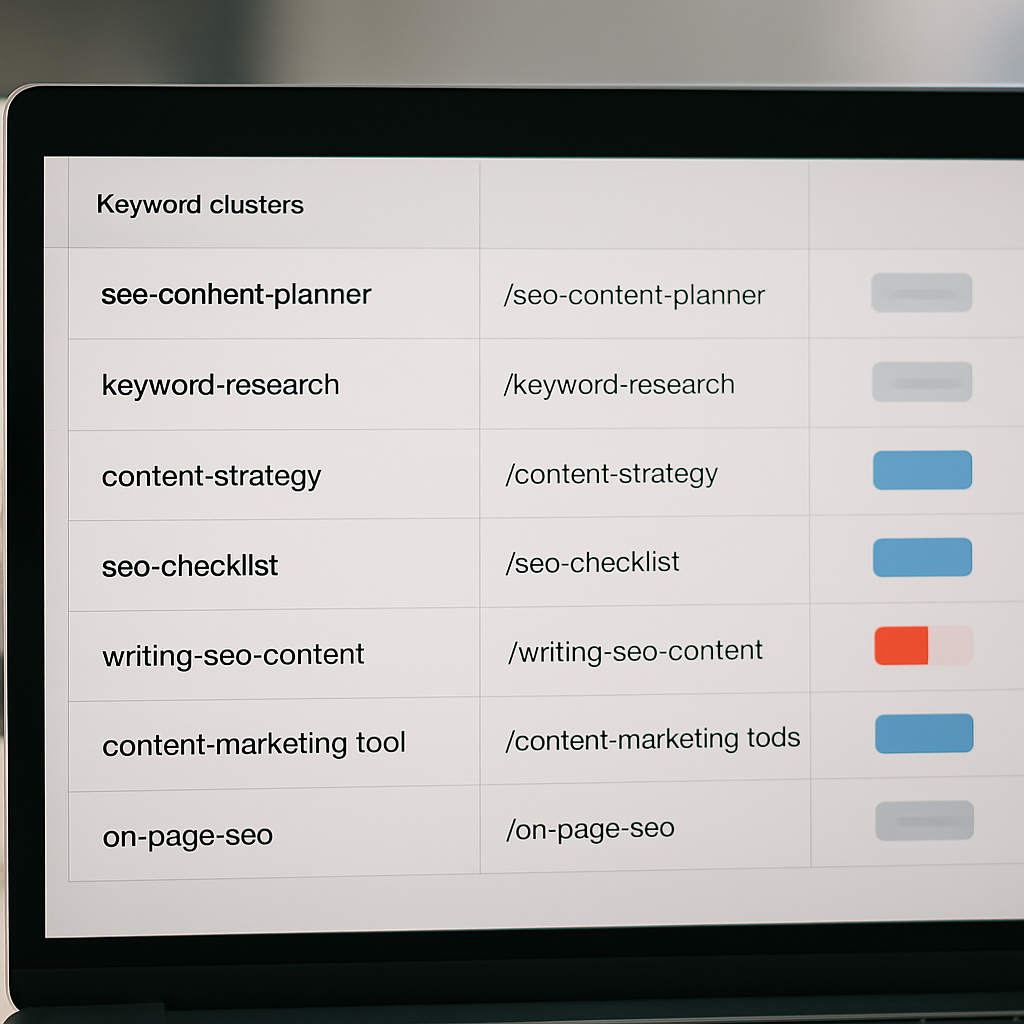
Next consideration: after you produce the gap list, route high-priority clusters into your content calendar and generate data-driven briefs so writers know whether to expand, merge, or replace existing content.
3. Prioritize topics using effort, impact, and intent
Prioritization decides whether your planner produces leverage or noise. Use three practical dimensions to rank every topic: Impact (traffic and business value), Effort (time, design, backlink needs), and Intent match (how closely searcher intent aligns with your conversion goal).
A concise scoring framework
Score each candidate topic on a 1 to 5 scale in the three dimensions, then compute a weighted total. Use higher weight for Intent when your goal is conversions, or higher weight for Impact when you need raw traffic growth.
- Step 1: Estimate Impact using your seo content planner and a keyword research tool like Ahrefs to surface monthly search volume and SERP traffic shares.
- Step 2: Estimate Effort as person-hours plus technical or design work and an estimate of backlink outreach needed. Include editing and QA time.
- Step 3: Determine Intent match by inspecting the SERP: are top results product pages, review lists, or how-to guides? Match that to your KPI.
- Step 4: Apply weights (example: Impact 40, Effort 30, Intent 30) and rank topics by final score.
| Topic | Effort | Impact | Intent match | Recommended action |
|---|---|---|---|---|
| seo content planner template | 2/5 (low) | 4/5 (high) | 5/5 (how-to, high conversion support) | Create long-form template + downloadable asset |
| seo content workflow | 3/5 (medium) | 3/5 (moderate) | 4/5 (informational, helpful for onboarding) | Publish guide and link from pillar page |
| seo content planner tools | 4/5 (higher: reviews and comparisons) | 5/5 (high traffic) | 2/5 (researchers, lower conversion intent) | Publish comparison but require strong promotion/backlinks |
Concrete example: The team ranked seo content planner template highest because it required minimal design, aligned with purchase intent for trial users who search for templates, and could be packaged as a gated download to capture leads. The tools comparison, despite larger traffic potential, fell lower because its intent skewed toward research and would need sustained backlink outreach to compete.
Practical tradeoff: high-impact topics often demand external signals such as backlinks or brand authority to rank. If your site lacks domain strength, prioritize low-effort, high-intent long-tail pieces that consolidate into a pillar page. That sequence builds topical authority faster than chasing high-volume head terms blindly.
A common misstep is treating volume as a proxy for value. Pages that drive sessions but not conversions waste editorial bandwidth. Use your seo editorial calendar to reserve promotion and backlink budget for topics where the Intent match is weak but Impact score is attractive.
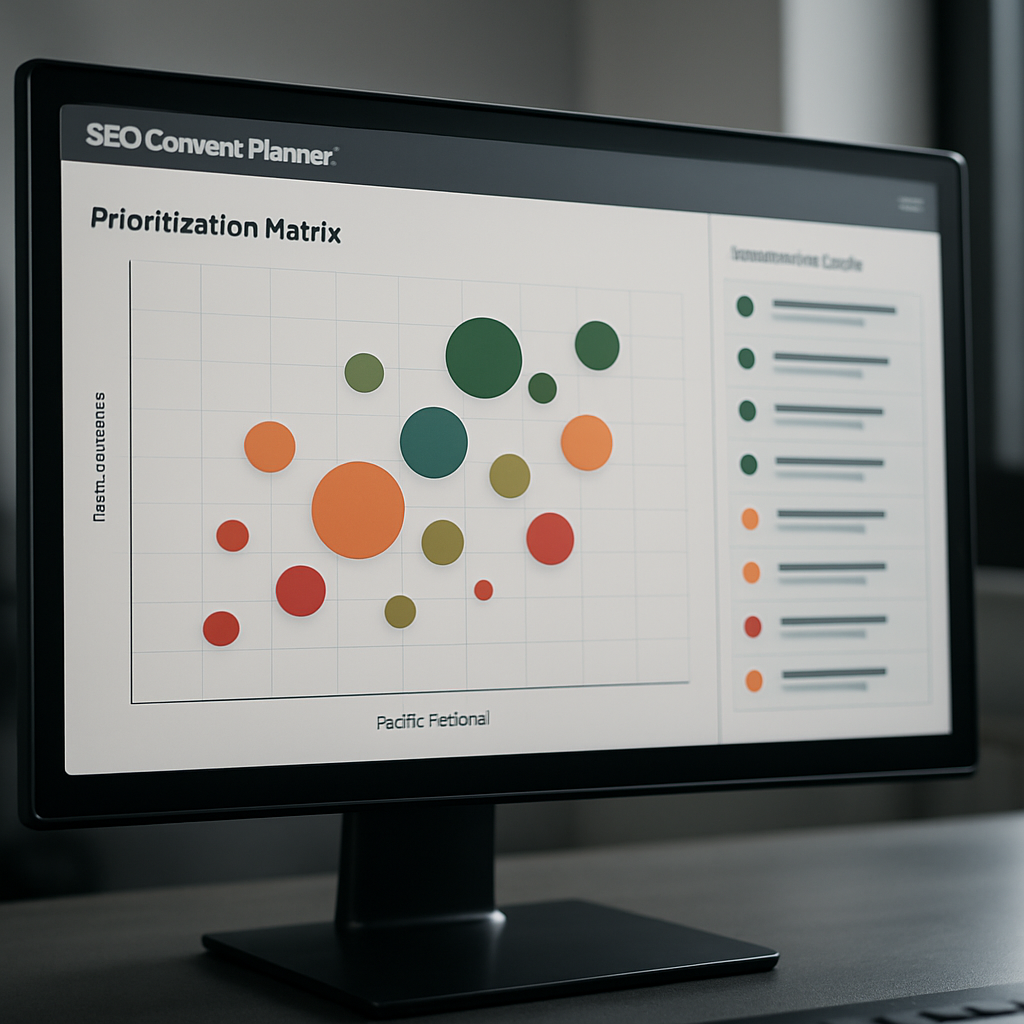
Next consideration: once prioritized, attach specific success KPIs to each topic in the planner and decide whether the play requires organic-only testing or paid promotion and backlink outreach before you publish.
4. Build a reproducible, data-driven content brief template
Core assertion: A brief is not optional documentation — it is the operational specification that turns an idea into a rankable page. If your briefs are inconsistent, your writers will guess structure, your SEO reviewer will replay the same fixes, and velocity collapses under rework.
Minimum fields for a reproducible brief
- Target keyword cluster: primary and 6–12 secondary keyword variants with intent tags (informational, transactional, navigational).
- Primary success KPI and timeframe: e.g., target position 1–5 in 3 months, expected monthly sessions, and conversion event to track in GA4.
- SERP snapshot and top-5 competitor notes: include screenshots or links and one-line reasons why each competitor ranks (backlinks, freshness, format).
- Required headings and section word ranges: H2/H3 skeleton with suggested word counts per section to guide depth without locking the writer.
- Must-cover facts and source links: named data points, studies, product references, and permitted external sources for citations.
- Internal linking targets and preferred anchor text: specify pillar pages, related posts, and any canonical rules.
- CTA and page goal: exact CTA text, funnel step, and tracking parameters to use on publish.
- Meta drafts and schema guidance: suggested title, meta description, and whether FAQ or HowTo schema is required.
- Assets and accessibility notes: images, charts, required alt text, and video embeds if applicable.
- Promotion brief: 1-line distribution plan (email, social, backlink outreach) and who owns each channel.
Tradeoff to manage: Be prescriptive about signals that affect ranking and conversion, and permissive about prose and storytelling. Over-constraining H2 wording and phrasing produces SEO-optimized but bland copy that underperforms for engagement. Make the brief enforceable on structure and intent, but leave creativity for the writer to convert facts into persuasive content.
Concrete example: For the article How to Use an SEO Content Planner to Scale Content That Ranks, include a headline H2 set such as: Overview of an seo content planner, Building a repeatable brief, Measuring success with rank tracking, and What to avoid. Assign internal links to the pillar content strategy page and to Ranklytics features for tooling references. KPI: target keyword cluster seo content planner, top 5 in 3 months, CTA = download the planner template gated behind an email capture.
Judgment call: Relying solely on AI to fill brief fields is fast but risky. Use an seo content planner that autogenerates SERP intent summaries and suggested headings, then require a human check for SERP features like featured snippets and People Also Ask. Machines miss nuance in intent shifts and can recommend headings that mimic competitors without adding unique value.
Operational tip: Treat each brief as a living artifact. Save a versioned copy of the brief pre-publish, then append a post-publish snapshot after 4 and 12 weeks showing rank, CTR, and conversions. Feed those results back into the template defaults so future briefs reflect what headings, word counts, or asset types actually moved the needle.
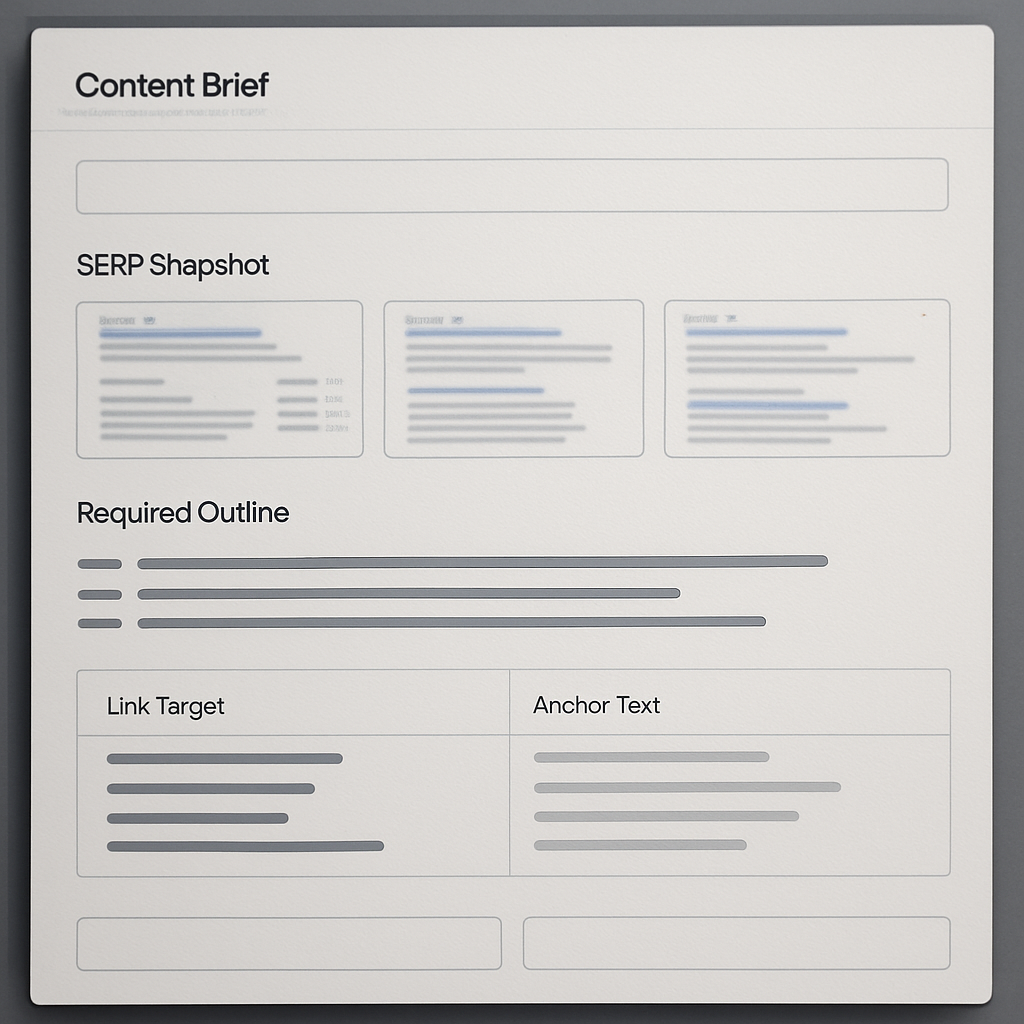
Next consideration: Connect this brief template to your calendar and assignment workflow so briefs travel with the task — that linkage prevents lost context and makes post-publish measurement and iteration automatic in your seo editorial calendar.
5. Design a workflow and content calendar for scaling production
Practical assertion: the calendar is not a list of publish dates — it is a schedule of milestones that enforce quality gates and measurement. Treat each content piece as a mini-project with named owners, fixed SLAs for each milestone, and an explicit post-publish review window.
Core workflow milestones
Use these milestone fields in your planner so nothing falls through the cracks: Topic accepted, Brief approved, Draft due, SEO review, Final edit, Publish, and Post-publish check (rank + GA4 metrics). Track dates for all milestones in the calendar rather than only the publish date — this reveals bottlenecks and makes capacity planning measurable.
- Who owns what: assign one owner per milestone (topic owner, brief author, writer, editor, SEO reviewer, publisher).
- SLA examples: Brief approved = 3 business days after topic assignment; Draft due = 5 business days after brief approval; SEO review = 2 business days.
- Status fields: use
Draft,In SEO review,Ready to publish,Published,Monitor— these map clearly to Kanban boards or exportedCSVworkflows.
Cadence trade-off: batching raises throughput but increases feedback lag; single-piece flow is faster for urgent content but burns editorial bandwidth. For small teams, batch 4–6 similar briefs and run a weekly edit sprint. For larger teams, run parallel streams with templated briefs to reduce coordination overhead.
Concrete example: a three-person marketing team used a weekly sprint: Monday — align and approve two briefs; Tuesday/Wednesday — writers produce drafts; Thursday — editor + SEO reviewer iterate; Friday — one piece publishes and one goes to Monitor. This cadence doubled publish velocity without more hires because briefs were standardized and the calendar enforced the SLA windows.
Integration insight: link your calendar to your seo content planner so briefs, SERP snapshots, and rank targets live with the task. Use Ranklytics features to sync keyword clusters and export assignments via CSV or API — that prevents lost context at handoff and lets post-publish metrics attach to the original brief.
Standardize three mandatory fields on every calendar entry: target keyword cluster, primary KPI, and post-publish review date. If any entry lacks these, it stays in Planning.
Next consideration: once the calendar runs, measure cycle time per milestone and reallocate capacity where delays occur — speed without quality is waste, so use the planner to balance throughput and ranking outcomes.
6. Publish with on-page optimization and internal linking strategy
Publish is the enforcement moment. After weeks of clustering, briefing, and writing in your seo content planner, small on-page mistakes or lazy linking decisions will cancel the work. Treat each publish as a checklist-driven release: the brief, target cluster, and KPI must travel with the page into production so nothing crucial is lost in the CMS handoff.
Three on-page buckets to validate before hitting publish
- Content signals: Ensure the above-the-fold summary matches search intent, headings follow the brief skeleton, and section depth maps to the keyword cluster (use the seo content planner to compare recommended H2s to top competitors).
- Behavioral and conversion signals: Include the right CTA for the page goal, visible navigation to related resources, and a clear next step for the user; these affect engagement metrics that feed ranking algorithms.
- Technical and index signals: Confirm canonical tag logic, meta robots/index settings, schema type appropriate to intent (FAQ/HowTo for how-to intent), and page performance thresholds for LCP and CLS.
Internal linking is strategic, not decorative. Link placement should map to user journeys and to the topical hierarchy you built in your seo editorial calendar. Prioritize links from the most authoritative topic pages to new cluster pages, use descriptive anchors that explain the destination, and cap the number of contextless links on a page to avoid diluting relevance.
Tradeoff to manage: aggressive internal linking can boost discoverability but it also risks confusing conversion flows and creating awkward UX. In practice, fewer well-placed contextual links outperform dozens of footer or sidebar links for both SEO and conversion outcomes. If you must add many links for editorial reasons, stagger them across the page and ensure the primary CTA remains prominent.
Concrete example: From your content strategy pillar page on content operations, add two contextual links to this article: one anchor reading seo content planner workflow linking to the section on briefs, and one anchor reading publish optimization checklist linking directly to this guide. Place the first link in the explanatory paragraph that discusses briefs and the second near the end of the pillar where readers expect tactical takeaways.
Internal links should answer the reader's next question. If a link does not materially help a user complete a task, remove it—even if it seems helpful for SEO.
Final judgment: the best use of an seo content planner at publish is not autopilot optimization; it is enforcement. Use the planner to lock in intent, anchor rules, and the post-publish measurement window. That discipline prevents common failures—weak anchors, missing canonicals, and no follow-up—but it does require a short, non-negotiable QA step in your calendar.
7. Track performance, iterate, and scale through pruning and consolidation
Hard rule: measurement should trigger actions, not produce dashboards. Configure your seo content planner so rank and engagement thresholds automatically flag pieces for specific follow-up: update title/meta, expand sections, merge with a stronger page, or retire with redirects. Use Ranklytics rank tracking to capture SERP snapshots and pair those with GA4 events so you can tie position movement to real user behavior.
Monitoring cadence and the signals that matter
Minimum signals: track position distribution for your target cluster, impressions-to-CTR, landing-page sessions, and the conversion event defined in the brief. Do not treat sessions alone as success.
Practical cadence: capture daily rank snapshots for the first 14 days after publish, then switch to weekly checks until week 12, and quarterly audits thereafter. For pages in consolidation or recovering from a major rewrite, run an accelerated 4-week cycle with weekly SERP feature checks.
- Decision rule — Update: If a page climbs into positions 6–20 but CTR is below your expected baseline (example: below 2% for high-intent keywords), update the title/meta and the above-the-fold content within two weeks and re-run the SERP snapshot.
- Decision rule — Consolidate: If multiple URLs each rank in low positions for the same intent and the combined traffic is low, consolidate into a single authoritative resource, 301 the weaker URLs, and merge useful sections into the canonical page.
- Decision rule — Prune: If a page has negligible impressions and no realistic keyword opportunity after 6 months, archive or remove it. Prefer a staged approach: mark noindex and monitor downstream traffic impact for 30 days before issuing permanent redirects.
Tradeoff to consider: consolidation improves authority but can wipe out small pockets of long-tail traffic if you redirect aggressively. Preserve useful long-tail phrases by mapping their keywords into the merged page's H2s and anchor sections precisely; otherwise you lose discoverability for niche queries.
Concrete example: A marketing team merged four short how-to posts about building a content calendar into one comprehensive guide in their seo content planner. After consolidation and targeted internal links from the pillar page, combined organic sessions rose from ~200/month to ~1,000/month over three months and several secondary keywords moved into the top 10. The team kept one legacy URL as a 301 redirect and added section anchors so the long-tail queries still landed in-page.
Common mistake: teams prune based only on low traffic and assume the content has no value. In reality, pages often contribute as assisted conversions or support downstream funnels. Check assisted-conversion paths in GA4 before deleting and prefer noindex staging when uncertain.
Automate flags in your seo content planner: when a post hits a rule (CTR, rank band, or conversion change), create a task with the recommended action and a deadline. That turns measurement into repeatable operational steps.
Next consideration: bake consolidation and pruning into your roadmap as recurring projects, not one-off cleanups. That prevents slow content debt from accumulating and keeps your content estate focused on pages that actually move business outcomes. For how-to details on configuring rank alerts, see Ranklytics features and indexing guidance at Google Search Central.
Frequently Asked Questions

Written by
Michael TorresMichael is an SEO analyst and data nerd obsessed with rank tracking, SERP trends, and algorithm updates. He has spent the last 6 years turning search data into actionable content strategies for startups and growth-stage companies.