











Table of Contents
- 1 Automating Content Creation with AI: Risks, Rewards, and Best Practices
- 1.1 1. Executive summary of rewards and risks
- 1.2 2. Decision framework: what to automate and what to keep human
- 1.3 3. Architecture and tools for safe automation
- 1.4 4. Step-by-step implementation playbook
- 1.5 5. Quality assurance and detection controls
- 1.6 6. Governance, ethics, and compliance
- 1.7 7. SEO measurement, experimentation, and iteration
- 1.8 8. Practical examples and templates
- 1.9 9. Long term considerations and roadmap
Automating Content Creation with AI: Risks, Rewards, and Best Practices
If your team is evaluating automating content creation to boost output and cut costs, you need a clear view of what actually scales and what breaks rankings. This guide delivers a practical, step-by-step playbook, decision rules, an SEO-first tool stack, human-in-the-loop checkpoints, and governance to control legal, quality, and search risks. Use the templates, prompts, and measurement checkpoints here to run a safe pilot, quantify ROI, and avoid the common traps that turn machine-generated content into ranking penalties.
1. Executive summary of rewards and risks
Plain fact: automating content creation delivers scale and speed but increases exposure to search penalties, factual errors, and brand dilution unless you add human controls. This section gives the tradeoffs you need to decide whether and how to automate.
Primary rewards
- Speed and throughput: produce first drafts, title and outline variants, or meta descriptions in minutes instead of hours.
- Lower marginal cost: produce large volumes for category pages, FAQs, and product descriptions at a fraction of hiring freelance writers.
- Consistent SEO scaffolding: automate keyword placement, internal link suggestions, and schema templates to maintain structural SEO quality across hundreds of pages.
Primary risks
- Search penalties and manual actions: auto generated low-value text is explicitly flagged by Google as spam – proceed with human review or risk ranking drops. See Google Search Central.
- Hallucinations and factual drift: models can invent specifics and plausible sounding but false claims; this is costly when content influences purchase or legal decisions.
- Copyright and similarity issues: high-volume outputs can mirror training data or competitor pages closely, triggering plagiarism flags and brand risk.
Practical tradeoff: if your goal is raw velocity for low-complexity tasks, automation gives clear ROI. If your goal is sustained topical authority or legal accuracy, automation must be hybrid – use AI for research and drafting, humans for verification and unique insight. In practice, teams that skip the human verification stage win speed but often lose ranking and trust.
Concrete example: A mid-stage SaaS company automated first drafts and meta descriptions for 60 backlog posts. Initial output cut writing time by about 70 percent, but editors still spent 20 to 35 percent of that saved time on factual checks and adding proprietary examples. After applying a required human signoff and running Originality.ai checks, the pages retained rankings and traffic continued to grow.
Key judgement: automation is not an either/or. The real value is unlocked when automation reduces mundane work and frees skilled writers to add unique data, case studies, and E-E-A-T signals.
For next reading on implementation and governance, see the Ranklytics walkthrough on pros and cons of AI in content writing: The Pros and Cons of AI in Content Writing: A Comprehensive List.

2. Decision framework: what to automate and what to keep human
Directly decide by risk, complexity, and proprietary value. Not every piece benefits from automation; the right question is not can we automate, but what will break if we do.
Four evaluation criteria. Score each content task on: content purpose (informational vs transactional), complexity (factual depth, nuance), need for proprietary insight (customer data, internal metrics), and legal/regulatory sensitivity (medical, financial, legal claims). High combined score = keep human.
| Content type | Recommended automation level | One-sentence rationale |
|---|---|---|
| Meta descriptions & title tags | Full automation (with sampling audit) | High volume, low risk, and easy to validate for CTR improvements. |
| Product short descriptions (eCommerce) | Hybrid (AI draft + QA) | Saves time but needs product-specific facts, SKU correctness, and legal checks. |
| Informational blog first drafts | Hybrid (AI draft + human edit) | Good for scale, but human edits required for E-E-A-T, unique examples, and citations. |
| Customer case studies & interviews | Manual | Requires proprietary data, quotes, and narrative craft that AI cannot reliably reproduce. |
| Legal, medical, or regulated advice | Manual with expert signoff | High risk of hallucination and legal exposure; automated drafting is unacceptable without review. |
| FAQ / Knowledge base (common issues) | Hybrid to Full (depending on complexity) | Routine, repeatable answers can be automated; escalate exceptions to humans. |
How to operationalize the matrix
- Inventory and tag. Export your content map (CMS pages, templates, landing pages) and tag each item with the four evaluation criteria.
- Set automation policies. For each tag combination, assign one of three modes:
full,hybrid,manualand define the human-in-loop checkpoints for hybrid items. - Pilot and measure. Run a small batch per mode, track SEO KPIs via Ranklytics and Google Search Console, and compare against human baselines before scaling.
- Enforce redlines. For anything tagged legal/regulatory or proprietary, require expert signoff and block direct model publishing via your CMS pipeline.
Concrete example: A SaaS content team automated meta descriptions and draft outlines for a 50-article content push, then routed drafts to product SMEs for two edits: accuracy of feature claims and one proprietary case stat. That hybrid cut drafting cost by ~60% while preventing factual errors that previously caused churned edits.
Practical trade-off to accept. If you push automation further than the content maturity supports, you gain velocity but lose distinctiveness—search engines and users penalize generic, interchangeable pages faster than before. Measure distinctiveness with semantic similarity tools and reserve fully automated publishing only for low-stakes templates.
Key judgement: Automate for scale where verification is cheap and failure cost is low; keep humans where the content carries reputation, legal, or commercial weight.
3. Architecture and tools for safe automation
Start with modularity, not a single point solution. Treat automating content creation as a pipeline with at least three separable layers: planning and briefs, generation, and verification plus measurement. If any of those layers are tightly coupled to one vendor you lose auditability, governance, and the ability to swap models when behavior changes.
Core stack components and recommended tools
- Planning & keyword research:
RanklyticsandSEMrushfor cluster discovery, keyword intent, and brief templates that feed the generator. - Outline & brief generation:
Ranklytics+GPT-4(or Claude) to create SEO-structured briefs with explicit constraints and sources. - Draft generation:
OpenAI GPT-4orAnthropic Claudefor first drafts; use model version pinning and cost-aware batching for scale. - Semantic optimization:
SurferSEOorClearscopeto measure topical coverage — use suggestions as input signals, not blind rules. - Factual verification / RAG: vector DB like
PineconeorWeaviatewith a retrieval layer so models cite internal docs and canonical sources. - Originality & plagiarism checks:
Originality.aiorCopyscapeas an independent gate before editorial review. - Grammar & tone:
Grammarlyor in-house style linter for brand voice enforcement. - Publishing & tracking: CMS webhooks +
Ranklyticsand Google Search Console for KPIs and alerts.
Practical trade-off: Use semantic optimization tools to find gaps, but avoid letting them auto-edit headings. Tools like Surfer are useful for coverage signals; they are not a substitute for unique insight and E-E-A-T.
Integration patterns, operational controls, and auditability
- Orchestration layer: build an API middleware (Node/Python) that sequences briefs -> RAG lookup -> generation -> verification -> staging. This gives retries, rate-limit handling, and centralized logging.
- Prompt & artifact versioning: store every prompt, model version, RAG snapshot, and generated output in a searchable audit store (git + DB). You will need this for regressions or policy disputes.
- Human-in-loop gates: require editorial signoff hooks in the pipeline; use staged publishing (draft -> QA -> publish) with timestamped approvals.
- Privacy & policy controls: filter PII before sending to external models and follow OpenAI policy on sensitive content and retention.
Cost and latency considerations that matter. Token costs scale with draft length; generating thousands of long-form pieces without batching or caching RAG responses becomes expensive fast. Lower-latency modes (smaller context windows, fewer retrieval rounds) save money but increase hallucination risk. Pin models when you can; model drift is real and will change output tone and factual reliability.
Concrete example: A SaaS content team used Ranklytics to produce briefs, ran a RAG-enabled GPT-4 draft stage, checked originality with Originality.ai, and required a single editor review before staging. The pipeline cut first-draft time by roughly 60% while keeping hallucinations low because the retrieval step enforced citations from the company knowledge base.
Next consideration: map this stack to a 10-topic pilot, pin model versions, and define the verification gates you will not bypass when you scale.
4. Step-by-step implementation playbook
Start small and treat automation like a release cycle. Run a tightly scoped pilot, measure impact against baselines, then expand. Automation is not a one-off tool swap; it is a workflow change that requires instrumentation, guardrails, and a rollback path if rankings move the wrong way.
Phased playbook
- Phase 0 – Pilot design: Pick 10 topics that represent your content mix, set KPIs (organic clicks, impressions, time on page, conversions), capture current baseline in Ranklytics and Google Search Console, and nominate editorial owners.
- Phase 1 – Automated briefing: Generate structured briefs with target keywords, search intent, content gaps, required data points, and internal link targets. Include a Ranklytics brief field list such as Target keyword, Intent, Competitor top URLs, Required stats, and Suggested related keywords.
- Phase 2 – Draft generation: Use constrained prompts to produce titles, H2s, and a first draft limited to word count and citation rules. Enforce a forbidden claims list and require inline sources for factual statements.
- Phase 3 – Human verification: Editors run factual checks, insert proprietary insights, tune voice, and mark E-E-A-T attributes. Implement three mandatory signoffs: Brief approval, Fact/Legal check, SEO+Publish approval.
- Phase 4 – Publish and observe: Push to CMS, tag articles in Ranklytics, run semantic and schema checks, and monitor performance daily for the first 14 days then weekly for 90 days. If a downward trend exceeds pre-set thresholds, revert or rework the page.
Practical tradeoff: Automating briefs and first drafts saves editing hours, but the marginal cost of human review does not scale down linearly. Expect editor time per article to drop by a fraction, not to zero. If you push for full automation, your risk of subtle quality loss and ranking regressions rises faster than cost savings.
Checklist with acceptance criteria
| Phase | Clear acceptance criteria |
|---|---|
| Phase 0 – Pilot ready | 10 topics selected, baselines recorded in Ranklytics, editorial owner assigned, success thresholds defined |
| Phase 1 – Brief accepted | SEO brief includes intent, 3 target keywords, competitor URLs, required data points, and internal link suggestions |
| Phase 2 – Draft accepted | Draft contains inline citations for facts, meets word count, avoids forbidden claims, and passes plagiarism scan |
| Phase 3 – Signoffs | Three approvals logged, proprietary examples inserted, E-E-A-T notes attached |
| Phase 4 – Live monitoring | Content tagged in Ranklytics, rank/traffic alerts active, 30 day check scheduled |
Concrete Example: A mid-market SaaS company piloted automated onboarding tutorials. They used Ranklytics to pull topic gaps, generated first drafts with OpenAI using strict prompts, and required product managers to add one proprietary customer vignette per article. Result: drafts delivered 60 percent faster and editors typically spent 20 to 30 minutes adding product specifics and correcting two factual items per article.
Prompt template – 1,200 word blog draft: Produce a neutral, practical 1,200 word article on SaaS onboarding that targets the keyword onboarding best practices for SaaS. Include H1, 4 H2s, a short intro, actionable steps, one customer example placeholder, and a conclusion with CTA. Cite public sources inline for any statistic. Do not make medical or legal claims. Word limit 1,200 +-10 percent. Forbidden: invented numbers without citation.
Require traceability: every AI draft must store the prompt, model, and model parameters used. This data is critical if you need to audit content or roll back changes.
Final judgment: Move deliberately. The fastest wins at volume, but the wrong automation before your monitoring and signoffs are mature will cost rankings and trust. Run controlled rollouts, instrument everything in Ranklytics, and treat each phase as reversible until performance is proven.
5. Quality assurance and detection controls
Key point: Treat quality assurance as an automated test suite, not an optional editorial add-on, when automating content creation. If your QA is manual and ad hoc, scale will produce noise: duplicated ideas, hallucinated claims, and search-engine penalties.
Automated checks to run (order matters)
- Originality/plagiarism: Run Originality.ai or Copyscape first to catch verbatim and near-verbatim copying; set a firm fail threshold (example below).
- Semantic novelty: Use a vector similarity model (SBERT or similar) to detect high overlap with top SERP pages — high lexical novelty with low semantic novelty is still risky.
- Citation density and source validation: Extract all factual claims and require inline citations for each; automated retrieval should match 80% of claims to primary sources or authoritative docs.
- Numerical and date checks: Run regex and fact-lookup tests for numbers, dates, percentages, and product specs; flag discrepancies for human review.
- Hallucination flags: Ask the model for claim confidence and supporting sources; treat low-confidence statements as automatically flagged.
- SEO/structural checks: Validate meta fields, canonical tags, schema markup, internal links, and required CTA elements before publish.
- Readability and tone: Run readability metrics and brand voice checks; fail pieces that diverge substantially from agreed tone profiles.
Sample QA pipeline and escalation rules
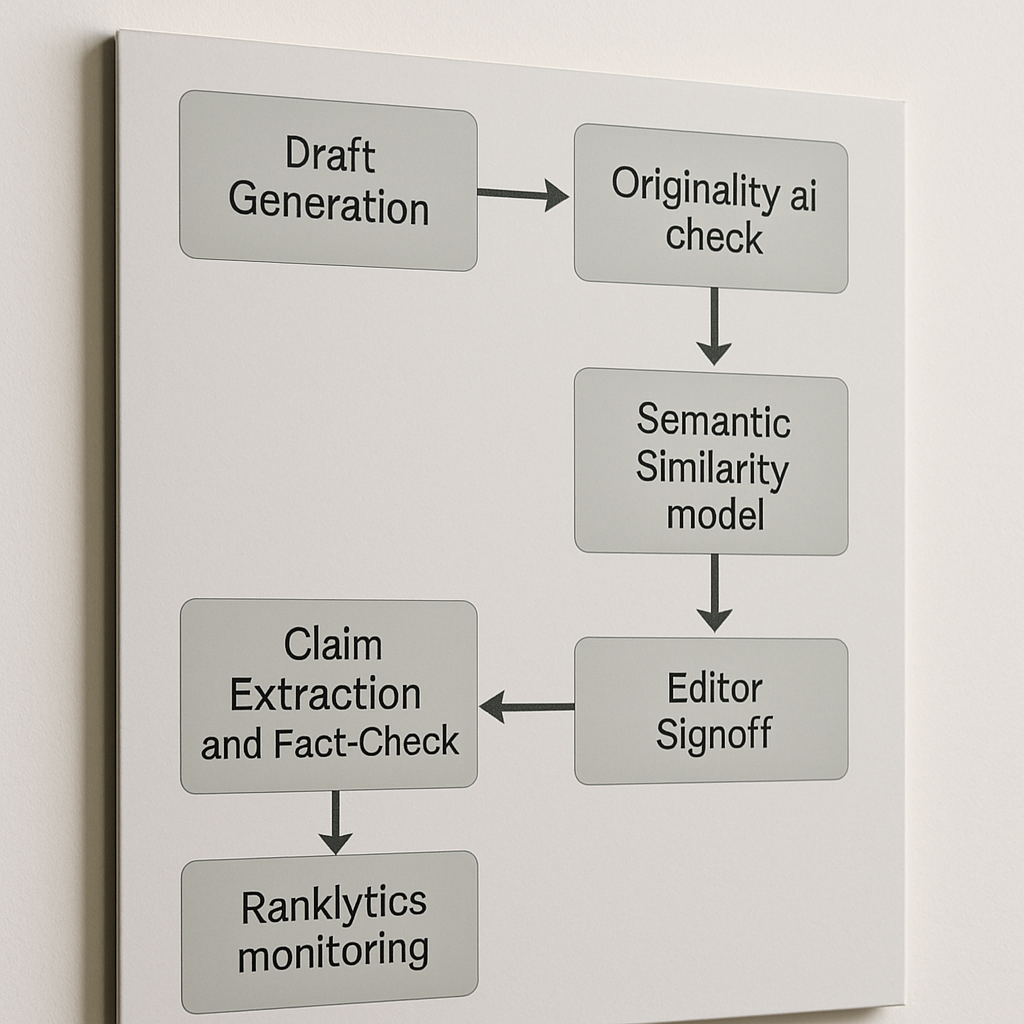
Pipeline: Orchestrate checks in CI-style steps: 1) run plagiarism and semantic-similarity tests, 2) auto-extract claims and validate against source set, 3) apply SEO structural validators, 4) route flagged items to editor queue with severity tags, 5) require two sign-offs (editor + SME for high-risk topics) before publish, and 6) tag content in Ranklytics for 90-day monitoring. Automate rollback: if organic clicks drop >30% or manual penalties are detected within 14 days, set the article to draft and start remediation.
Concrete Example: A SaaS content team publishing 60 posts/month enforces these rules: run Originality.ai, run a vector-check against the top five SERP results, and automatically extract five primary claims per draft for verification. If any claim fails lookup or originality <70%, the draft returns to the author with a mandatory SME note before any publish.
Practical trade-off: Tight thresholds prevent search penalties but reduce throughput and raise costs. In practice, set progressive gates: low-risk content (meta descriptions, short product blurbs) can tolerate lighter checks; high-risk content (how-to guides, financial/legal advice) must hit strict gates and SME signoff.
Reality check: Watermark and detector tools are useful but unreliable as single-signal controllers; they produce false positives and negatives. Rely on layered signals (plagiarism, semantic similarity, citation coverage) plus human review for edge cases.
Rule of thumb: Never accept an AI draft for publish based solely on a single tool's green light — require at least two automated checks plus one human signoff for publishable content.
6. Governance, ethics, and compliance
Straight rule: governance is not optional technical overhead — it is the control plane that prevents automation from becoming liability.** If you treat automating content creation as purely a production gain you will miss the contractual, legal, and reputational hooks that break projects at scale.
Core governance pillars
Policy: Define a narrow, practical policy that says what types of content may be generated, who must sign off, and which topics are forbidden for automated publication (legal, medical, financial advice). Link this policy from your editorial standards and your privacy policy.
Vendor and data controls: Contractually require a Data Processing Agreement and explicit model usage rights from any third-party model provider. Do not assume platform terms cover your downstream liability. Keep an inventory of which tools see confidential or customer data and block PII from prompts with runtime filters.
Practical trade-offs and limits
Trade-off — transparency vs. tactical advantage: Disclosing AI assistance builds trust and reduces legal risk, but over-sharing prompts or internal methods can erode competitive advantage. Choose a disclosure that is clear to users and regulators without publishing operational secrets.
Limitation — model provenance and copyright: You cannot reliably prove a model did not use copyrighted training data. That uncertainty means automated reuse of third-party text or wholesale copying from sources is a legal risk even if the model output looks original. Use licensed assets and run copyright checks before publish.
Concrete example
Concrete Example: An eCommerce team automated product descriptions for 10,000 SKUs. They blocked SKU-level PII from prompts, required manufacturer content licensing, and mandated legal signoff for any promotional claims. When a vendor sent a draft that reused manufacturer copy verbatim, the legal reviewer caught a licensing mismatch and prevented a DMCA exposure — saving the company from a takedown and a contract dispute.
Operational controls checklist
- Disclosure policy: Standard line on pages where content was AI-assisted and a site-level policy; follow FTC guidance on endorsements where applicable.
- Risk thresholds: Define content classes that require expert signoff (e.g., medical, legal, regulatory).
- Access controls: Limit who can run models and who can push AI drafts to CMS; use
SAML/SSO and role-based permissions. - Logging & audit: Keep immutable logs of prompts, responses, and editor changes for 90+ days to support investigations.
- Copyright checks: Integrate Originality.ai or Copyscape into the publishing pipeline and require remediation before publish.
- Privacy controls: Strip or block PII from prompts; document data retention and deletion rules in vendor contracts.
- Incident response: Predefine steps for takedown notices, hallucination-corrections, and SEO recovery (canonical rollbacks, 301s).
Judgment: In practice, the teams that succeed apply governance incrementally. Start with strict controls on high-risk content and gradually relax rules where metrics show safety. Overly permissive policies accelerate output but create audit debt that is costly to fix.
Minimum for a 30-day pilot: policy document, one legal reviewer, prompt logging, PII filter, and automated originality check before any public publish.**
Next consideration: Pair this governance framework with live monitoring in Ranklytics and routine legal reviews; governance without monitoring is theater, not control. For policy templates and deeper ethics guidance see The Ethics of AI in Content Writing and review Google’s spam policies for search-specific risk limits.
7. SEO measurement, experimentation, and iteration
Measurement is the control system for any content automation program. If you cannot attribute changes in rank or traffic to specific automation settings, you are flying blind and will amplify errors at scale.
Core principles
Focus on business outcomes, not vanity metrics. Track organic clicks, impressions, average position, and conversions together — a ranking lift with zero conversion improvement is not always a win. Use session-level conversion and assisted-conversion signals to connect content to revenue.
- Instrument everything: tag AI-produced pages at creation time (
ai_generated:true) and push that metadata into Ranklytics and your analytics platform. - Use time windows that matter: evaluate initial signal at 30 days, decision window at 60 days, and final verdict at 90 days for most informational content.
- Run small, controlled rollouts: test a 5-10% sample of URLs before bulk publishing to detect regressions early.
Practical trade-off: faster velocity creates more data but also more noise. Small-batch experiments slow scale but reduce risk of mass ranking drops. Choose based on traffic sensitivity: high-traffic pages get conservative rollouts; long-tail pages can be more aggressive.
Experiment framework (practical steps)
- Define primary KPI (organic clicks or conversions) and secondary KPIs (time on page, pogo-sticking rate).
- Create variants: baseline (human) and treatment (AI-first or hybrid). Store both versions and tag them in Ranklytics.
- Run a controlled rollout: push the treatment to a 5 10% URL sample or a low-traffic segment, mark variants with
noindexor canonical where appropriate to avoid duplicate content issues during the test. - Monitor daily for rank drops and weekly for conversion changes. Set automated alerts in Ranklytics for >15% position drop or >25% CTR decline within 14 days.
- If treatment passes 60 90 day thresholds, scale incrementally and continue monitoring for long tail behavior.
Common mistake I see: teams declare victory on short-term CTR lifts from reworded titles or meta descriptions. Ranking and user satisfaction need sustained evaluation; update decisions only after the full window to avoid flip-flopping and signal confusion.
| KPI | Evaluation window | Action threshold |
|---|---|---|
| Organic clicks | 30 90 days | Increase >10% (keep), Decrease >15% (rollback) |
| Average position | 30 90 days | Improve or stay stable: proceed; drop >5 positions: investigate |
| Conversion rate | 30 90 days | Improve or stable: scale; drop >10%: require human review |
Concrete Example: A SaaS site tested AI-first drafts for onboarding guides on 12 low-traffic pages. They rolled out to 10% of pages, tracked keyword-level rank in Ranklytics, and found stable rankings but a 12% increase in time on page after two months. They expanded to another 30% while requiring an editor to inject one proprietary tip per page to preserve E-E-A-T.
Judgment: Treat prompt and template tweaks as experiment variables. Iteration on prompts is where most practical gains come from, not swapping models. Track which prompt versions map to which performance changes.

Next consideration: decide the acceptable risk threshold for your site and bake it into the rollout cadence and alerting rules.
8. Practical examples and templates
Key point: Treat AI outputs as structured drafts and templates, not final copy. Automation speeds drafting but the quality delta comes from targeted prompts, constraints, and a mandatory human pass that injects proprietary insight and fixes factual drift.
Template A — Ranklytics brief to OpenAI draft workflow
Workflow: Generate an SEO brief from Ranklytics, pass the brief to OpenAI for a first draft, then run an editorial verification pass. This isolates tasks and makes review efficient.
- Inputs to Ranklytics brief: target keyword, search intent, top 5 competing URLs, desired word count, must-include data points, internal link suggestions.
- OpenAI title prompt: `Write 5 attention-safe titles for a 1,200 word post targeting
- Include one title that is question-based and one that is list-based.`
- OpenAI outline prompt:
From the brief produce an H2 and H3 outline with estimated word counts per section and two suggested data citations. Avoid making claims without sources. - OpenAI draft prompt:
Write a 1,200 word draft using the approved outline. Insert [SOURCE: URL] tags where a factual claim needs verification. Do not invent statistics. Tone: authoritative, pragmatic.
Practical insight: Use Ranklytics to tag generated pages so you can filter performance by automation level. That makes it possible to compare organic outcomes for AI-assisted drafts versus human originals.
Template B — Automated FAQ pages for eCommerce with schema
Use case: High-volume product catalogs where FAQs and short descriptions are repetitive and safe to automate with rules and spot checks.
- Data source: product attributes table (size, material, warranty) exported as CSV to feed prompts.
- Prompt pattern:
For product X generate 6 short FAQs (20 40 words) using only data from the CSV. Add a one sentence answer that cites the attribute field name in brackets. - Schema step: Auto-populate FAQPage JSON-LD using the Q A pairs and include
mainEntitywith@typeset toQuestionandacceptedAnswerfields. Validate with Google Rich Results test before publish.
Limitation: Automated FAQs save time but tend to be shallow. Reserve human review for pages that generate traffic or revenue above a threshold; otherwise automated content can accumulate and lower site-wide quality signals.
Real-world hybrid example — SaaS blog post
Concrete example: A SaaS product team ran a hybrid workflow for 20 onboarding articles. Average first-draft time fell from 6 hours to 45 minutes. Editors required one hour of edits per article to inject customer examples and correct three factual errors per draft. After 60 days, 12 of 20 posts matched or exceeded prior organic traffic baselines when tracked in Ranklytics.
Judgment: That outcome is typical. Automation buys velocity, not guaranteed ranking. The human step that adds proprietary examples and corrects hallucinations is where ranking value is earned.
Cautionary example and recovery pattern
Cautionary example: A site auto-published 1,500 thin product guides with minimal review and saw a 25 percent drop in organic impressions over a quarter. The content looked original but lacked depth and unique data.
- Recovery steps taken: audit and tag all automated pages in Ranklytics, set low-performing pages to noindex, consolidate near-duplicate pages with 301s and canonical tags, and plan high-value rewrites with subject matter experts.
- Time and cost tradeoff: recovery required two months of editorial work and temporary traffic loss; this often costs more than doing a slower hybrid approach up front.
Next consideration: Pick two templates to pilot this week – one narrow and low risk (product FAQ) and one high-value hybrid (feature deep dive) – then tag them in Ranklytics and measure 30 60 day outcomes against control pages. For policy guidance see Google spam policies.
9. Long term considerations and roadmap
Scale only after you can measure it. Before moving from a pilot to full program, require repeatable signals: stable or improving organic clicks for AI-assisted pages over two 30-day windows, originality scores above 90% on spot checks, and an average editorial review time that stays under your SLA. These are operational gates, not suggestions.
Scaling triggers and pragmatic thresholds
- KPI trigger: sustained +5% organic clicks or better for AI-tagged content versus baseline across 60 days.
- Quality trigger: random sample pass rate >= 92% on plagiarism and factual-checks (use
Originality.aiorCopyscape). - Operational trigger: average end-to-end turnaround (brief → publish) under 7 business days with no more than 10% rework rate.
- Risk trigger: zero manual search penalties or takedown notices in the past 90 days; monitor Google Search Central.
Trade-off to accept: faster velocity increases discoverability but also increases the absolute number of problematic pages you must audit. Scaling without stronger QA moves risk from a few failures to many — the cost of mitigation grows faster than incremental savings on drafting.
Staffing, cost model, and tooling maturity
| Function | Recommended headcount per 100 published articles/month | Primary responsibility |
|---|---|---|
| AI-assisted writers | 8–12 | Turn prompts into draft outputs and add proprietary data |
| Editors / fact-checkers | 6–8 | Quality, E-E-A-T enforcement, and citation verification |
| SEO analyst | 1 | Tagging, A/B tests, Ranklytics tracking, and alerts |
| AI operator / engineer | 1–2 | Prompting strategy, API orchestration, and rollback automation |
| Legal / compliance (part-time) | 0.2–0.5 FTE | Policy reviews, copyright checks, and disclosure guidance |
Practical constraint: budget shifts from content creation to verification and tooling as you scale. Expect tooling and monitoring to absorb 20–35% of the automation budget once you exceed 50 articles/month.
Concrete example: A SaaS content team moved from a 10-article monthly pilot to 120 articles/month. After the second month they saw 12 pages start to drop because of keyword cannibalization and thin top paragraphs. Recovery required adding a mandatory 150-word unique-insight section to each article, adjusting canonicals, and a rapid internal linking plan; rankings recovered within 8 weeks.
Audit cadence, model drift, and legal watch
- Continuous: real-time rank alerts via
Ranklyticsand automated originality scans on publish. - Weekly: 20-page rolling sample for editor spot checks and hallucination detection; require inline citations for all factual claims.
- Quarterly: full content audit for topical cannibalization, stale facts, and schema health; test two A/B experiments on title treatment and content length.
- Annually: review contractual exposure with model providers and revalidate data privacy measures against OpenAI policy and your legal team.
Ranklytics, enable automated originality checks, and schedule your first quarterly audit before you double output.Takeaway: scale methodically — treat automation as an operating system that requires governance, auditing, and budgeted remediation. If you cannot commit the people and tooling described above, slow the cadence until you can; scale without those controls and you trade short-term wins for long-term risk.

Written by
ranklytics